
Optimization 1
Section outline
-
-
University: Djilali Bounaama Khemis Miliana
Faculty: Material and Computer Sciences
Department: Mathematics
Level: L3
Module: Optimization without constraints
Semester: 05
Crédits : 05
Coefficient : 02
Lecturer: Dr. BOUKEDROUN. Mohammed
Diploma: Doctor in optimization and operational research
Grade: MCA
Contact: You can contact me on m.boukedroun@univ-dbkm.dz from.
-
-
Teaching Unit: Methodology
Course Title: Unconstrained Optimization
Credits: 5
Coefficient: 2
Course Objectives
This module provides an introduction to unconstrained optimization. Students who complete this course will be able to identify the fundamental tools and results in optimization, as well as the main methods used in practice. Practical sessions are included, with implementations carried out using the scientific computing software MATLAB, in order to better assimilate the theoretical concepts of the algorithms studied in the course.
Recommended Prerequisites
Basic knowledge of differential calculus in Rn
Course Content
Chapter 1: Review of Differential Calculus and Convexity
-
Differentiability, gradient, Hessian matrix
-
Taylor expansion
-
Convex functions
Chapter 2: Unconstrained Minimization
-
Existence and uniqueness results
-
First-order optimality conditions
-
Second-order optimality conditions
Chapter 3: Algorithms
-
Gradient method
-
Conjugate gradient method
-
Newton’s method
-
Relaxation method
-
Practical sessions
Assessment Method
-
Final exam: 60%
-
Continuous assessment: 40%
-
-
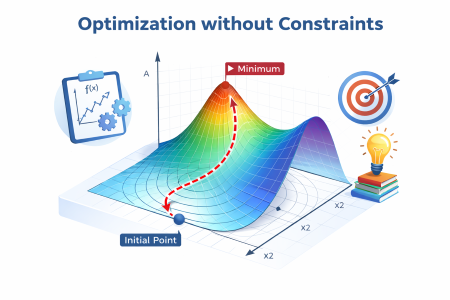
Studying unconstrained optimization is crucial for understanding how to find the optimal values of a function without any restrictions on the decision variables. It helps develop essential mathematical tools and techniques, such as gradient-based methods, which are fundamental in many fields like machine learning, engineering, and economics. This area of study also lays the groundwork for tackling more complex constrained optimization problems and enables the development of efficient algorithms for solving real-world optimization tasks, from minimizing costs to maximizing performance in various applications.
-
References:
Nocedal, J., & Wright, S. J. (2006). Numerical Optimization. Springer.
Boyd, S., & Vandenberghe, L. (2004). Convex Optimization. Cambridge University Press.
Luenberger, D. G. (1969). Optimization by Vector Space Methods. Wiley.
Press, W. H., Flannery, B. P., Teukolsky, S. A., & Vetterling, W. T. (1986). A method for solving unconstrained optimization problems. Computing in Science & Engineering, 3(1), 43-47.
Nocedal, J., & Wright, S. J. (1999). Gradient-Based Optimization Methods. Springer Handbook of Computational Mechanics, 13-54.
Boyd, S. (2020). Convex Optimization. Coursera. (Disponible sur : https://www.coursera.org/learn/convex-optimization).
Cormen, T. H., Leiserson, C. E., Rivest, R. L., & Stein, C. (2011). Introduction to Algorithms. MIT OpenCourseWare. (Disponible sur : https://ocw.mit.edu/courses/electrical-engineering-and-computer-science/6-006-introduction-to-algorithms-spring-2011/).