Micoeconomics 1
Section outline
-
-
Module Syllabus : Microeconomics1
Course Title : Microeconomics1
All Branches Included
Branch
Economics, Commercial and Management Sciences
The field
Gradation : Licence
Year : First Year
Level
Common Trunk
The Speciality
2024/2025
The University Year
The First
Semester
Course Identification
Basic Unit
Teaching Unit
Microeconomics1
Course Title
3
Coefficient
6
Number of Credits
3
Conference (number of hours per week))
4.5 H
Weekly volume of hours
 1.5
1.5Directed work (number of hours per week)
/
Practical work ( number of hours per week)
The Responsible for the Module
Professor
Degree
Mounia Khelfaoui
Full name
m.khelfaoui@univ-dbkm.dz
E-mail
/
Office location
Tuesday/Wednesday at Hall 3
T :10 a.m. to 11.30 a.m.
W :8 a.m to 10a.m
Locations and times of courses
0561416347
Phone number
Course Description
-Assimilation of some economic concepts
- Assimilation of mathematical knowledge
Acquired Knowledge
- To enable students to acquire a solid foundation that will facilitate the development of their cognitive, conceptual, analytical and interpretive skills in relation to various phenomena and behaviours at the microeconomic level ;
- To enable students to analyse and process economic phenomena, firstly using economic approaches and then using mathematical tools such as mathematical equations ;
- Identify methods and tools that help measure the rationality of decisions taken by the consumer and producer when spending; and understand the mechanisms for achieving equilibrium in the market..
General Aim of the Course
- Mastery of basic economic concepts and the theoretical framework of consumer and producer behaviour, and the ability to use quantitative tools to measure and scientifically analyse rational consumer and producer behaviour;
-The ability to make correct decisions, using economic logic, for any economic problem that involves the actions of consumers and producers ;
-The ability to understand individual consumption and production behaviour and to link effective and theoretical behaviour;
- learning an economic culture and developing their economic and rational behaviour based on how best to achieve individual goals.
Learning objectives skills to be acquired))
Course Content
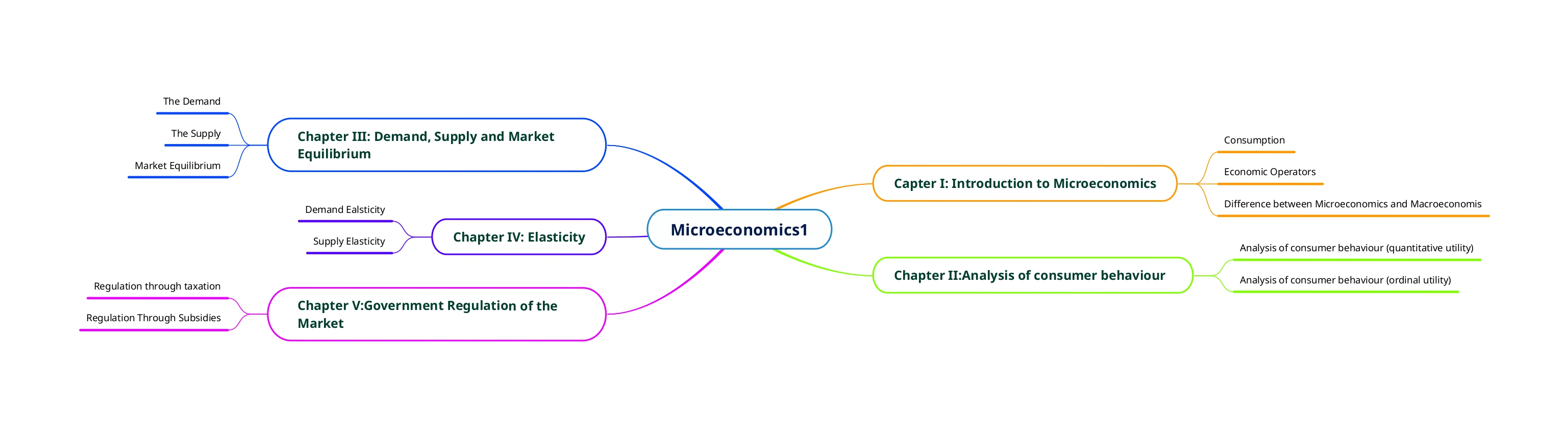
Chapter I : Introduction to microeconomics
Chapter II : Analysis of consumer behaviour (quantitative utility)
Chapter III : Analysis of consumer behaviour (ordinal utility)
Chapter IV : Demand, supply and market equilibrium
Chapter V : Elasticity
Chapter VI : Government regulation of the market
Chapitre VII : Analysis of producer behaviour (production)
Chapitre VIII : Analysis of producer behaviour (costs and revenues)
Evaluation Method
:
Module average
Course mark * 0.6 + Directed work * 0.4=
Average.A
= (Ex mark * 0.6) + ( Dw mark * 0.4)
) Sources and References (standardised at national level)
المرجع الأساسي الموصى به :
عنوان المرجع
المؤلف
دار النشر و السنة
Microeconomics
Michael PARKIN
Pearson education, 13thedition , 2019.
L’essentiel de la microéconomie
Bruno Gendron
Gualino,7eme édition, 2020.
النظرية الاقتصادية الجزئية المتوسطة
الأفندي محمد أحمد
(2020)، الجزء الثاني، مركز الكتاب الأكاديمي، الأردن
مراجع الدعم الإضافية (إن وجدت):
جوادي علي (2020)، الاقتصاد الجزئي تحليل نظري وتطبيقي، الجزء الأول، دار النشر الجديد، الجزائر.
عمار عماري(2015)، الاقتصاد الجزئي -ملخص الدروس وتطبيقات محلولة-، دار الجزائرية، الجزائر.
عمر صخري(2019)، الاقتصاد، دار بهاء الدين للنشر والتوزيع، الطبعة الأولى، قسنطينة، الجزائر.
فردريك تلون ترجمة وردية واشد (2008)، مدخل إلى الاقتصاد الجزئي، مجد المؤسسة الجامعية للدراسات والنشر والتوزيع، الطبعة الأولى، بيروت، لبنان.
كساب علي (2013)، النظرية الاقتصادية، التحليل الجزئي، الطبعة الرابعة، ديوان المطبوعات الجامعية، بن عكنون، الجزائر.
معاذ الشرفاوي الجزائري(2020)، الاقتصاد الجزئي، منشورات الجامعة الافتراضية السورية، سورية.
Armand Colin(2018), la microéconomie en pratique, DUNOD,France.
BIEN Franck et MERITET Sophie, (2019), Microéconomie : Comportements des agents et concurrence parfaite, Pearson,France.
Christopher T.S. Ragan(2019) , Ragan Microeconomics, Pearson, Canada.
Hal R. Varian(2006), Introduction à la microéconomie, traduction de la 7e édition américaine par Bernard THIRY, 6e édition, De Boeck, Bruxelles, Belgique.
Martin Kolmar ; Magnus Hoffmann(2018), Workbook for Principles of Microeconomics,
Michael PARKIN,Robin BADE, Patrick GONZALES(2010),Introduction à la microéconomie moderne, Edition du renouveau Pédagogique Inc, 4ème édition.
R Frank and E Cartwright(2016), Microeconomics and Behaviour (2nd ed), McGraw-Hill, Springer Texts in Business and Economics, ISBN 978-3-319-6661-1 .
VARIAN Hal, (2015), Introduction à la Microéconomie, De Boeck, 8eedition, France.
-
-
In this chapter, we will look at two concepts: the theory of marginal utility, and the theory of the indifference curve.

-
-
-
-

-
-
-
-
This space is for communication between the professors and the students