Linguistics
Section outline
-
-
-
This module,
Linguistics, is designed for third-year licence students and is offered as part of thefundamental unitin their degree programme. It introduces learners to key phenomena that characterise multilingual societies, with a particular focus on the Algerian context and other global settings. The module covers major topics such as diglossia, bilingualism, code switching, language borrowing, pidgins and creoles, globalisation and language planning, and shows how these concepts help explain real patterns of language use in everyday life, education, media and public institutions. Through lectures, guided discussion, and simple analytical activities, students learn to define and distinguish these notions, identify them in short authentic examples, and reflect on how social, political and economic factors influence language choice, linguistic change and the status of different languages and varieties in a given community. By the end of the course, students are expected to use basic sociolinguistic terminology with confidence, relate theoretical concepts to the Algerian situation, and develop a more informed and critical view of language issues in their professional and academic futures.
-
-
Do not hesitate to contact your teacher in case of need.!!!!

Welcome to the course of Linguistics!!!!! -
-

This forum is a space dedicated for ideas' exchange in the module. It permits students to discuss the content of the module and to ask questions related to the different concepts dealt with in the module.
Do not hesitate to participate actively for futher understanding!!!!! -
A space that favors group interaction and collaboration
This wiki is designed for encouraging communication among students. It is a space of exchange that encourages interaction and collaboration among group adherents
-
-

-
-
 Knowledge competence: understand the definitions and main features of diglossia, bilingualism, code-switching, borrowing, and variationist sociolinguistics.Analytical competence: identify and compare these phenomena in spoken or written discourse.Interpretive competence: explain why speakers change language or variety depending on context, interlocutor, and social setting.Linguistic competence: use the correct terminology and describe examples accurately.Communicative competence: discuss sociolinguistic issues clearly in oral and written form.Critical competence: reflect on how social factors such as class, age, gender, and identity influence language variation.
-
-
Prerequisites and recommended prior knowledge1. Prerequisites
Students are expected to have:-
- A basic understanding of language as a system of communication
- Fundamental knowledge of English grammar (sentence structure, parts of speech)
- Ability to read and understand simple academic texts
- Basic skills in note-taking and comprehension of theoretical explanations.
2. Recommended Prior Knowledge
For successful participation, students are also expected (though not formally required) to have
-
-
Diagnostic assessmentof this module allows to identify students' level and understanding in Linguistics.It also constitutes an important tool that helps to determine and assess the lacks and needs of students in order to design the course and adapt it accordingly.
-

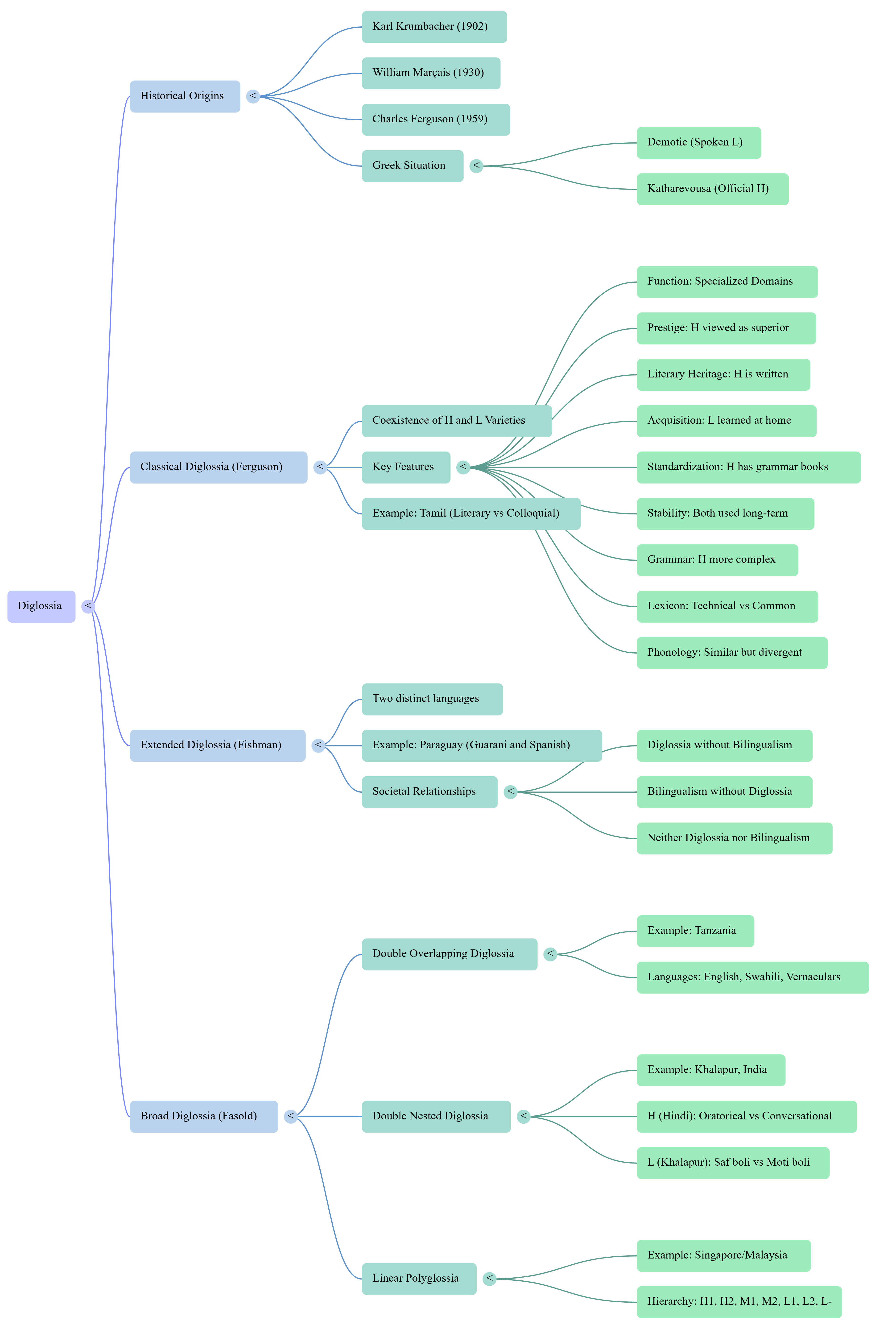
Lesson One: DiglossiaObjective:-Introducing students to the concept of diglossia as a key sociolinguistic situation.-Enabling students to describe and analyse the functional distribution of High and Low varieties within a speech community
Content:-Definition of Diglossia and its features
-Extended Diglossia
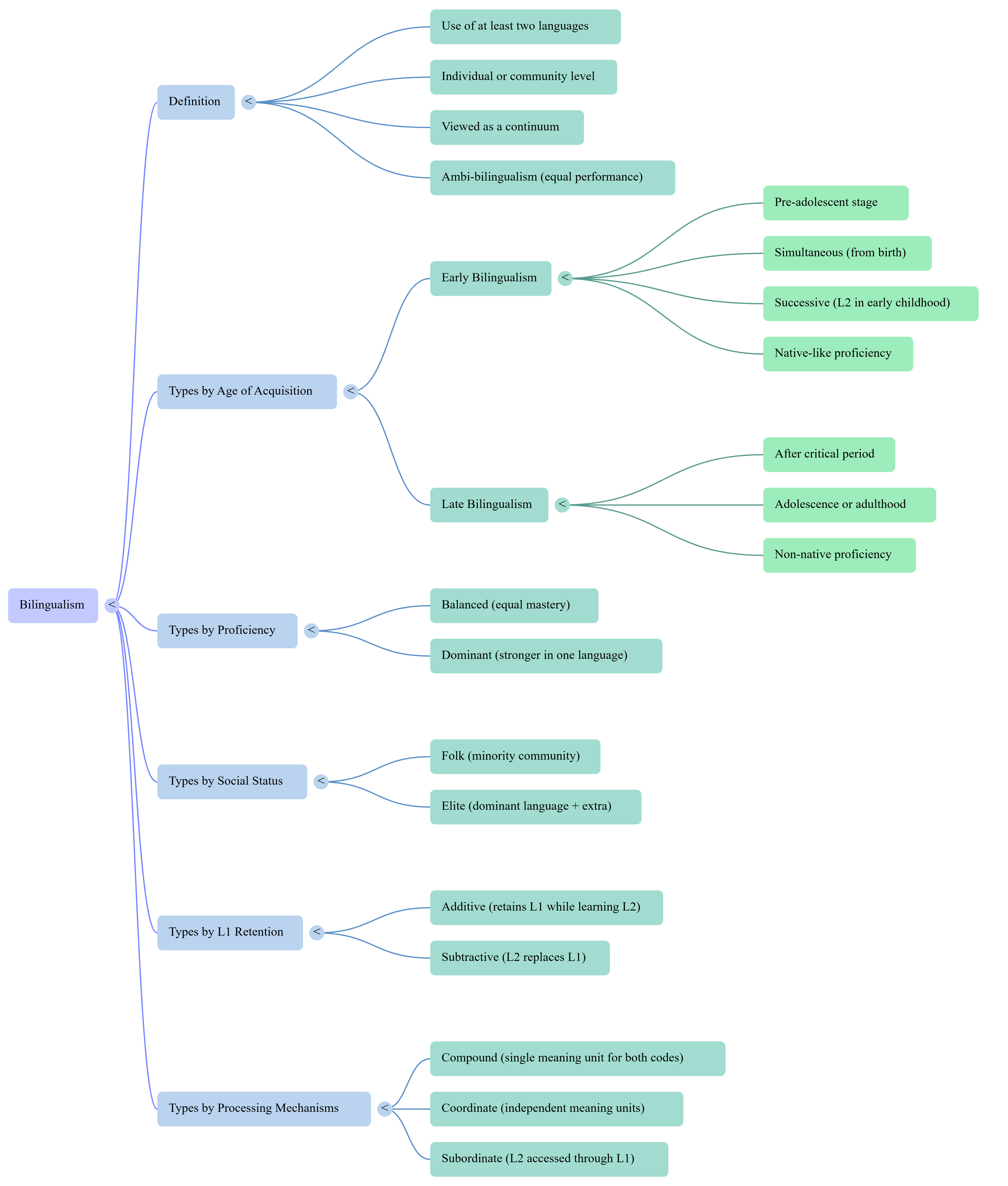
Lesson2: BilingualismObjectives:-Understanding the concept of Bilingualism from different perspectives-Identifying the different types of Bilingualism
Content:-The definition of Blingualism
Lesson3:Code-switchingObjectives:-Understanding code switching as a systematic feature of multilingual discourse, to distinguish it from related phenomena such as code mixing
-Developing students’ ability to interpret the communicative and social functions of code switching
Content:-The definition of Code-switching and its types
-Code switching vs Code mixing
-Functions of code-switching
Lesson four: Language BorrowingObjectives:-to understand language borrowing as a major outcome of language contact,
-to define and distinguish borrowing from code switching and related phenomena,
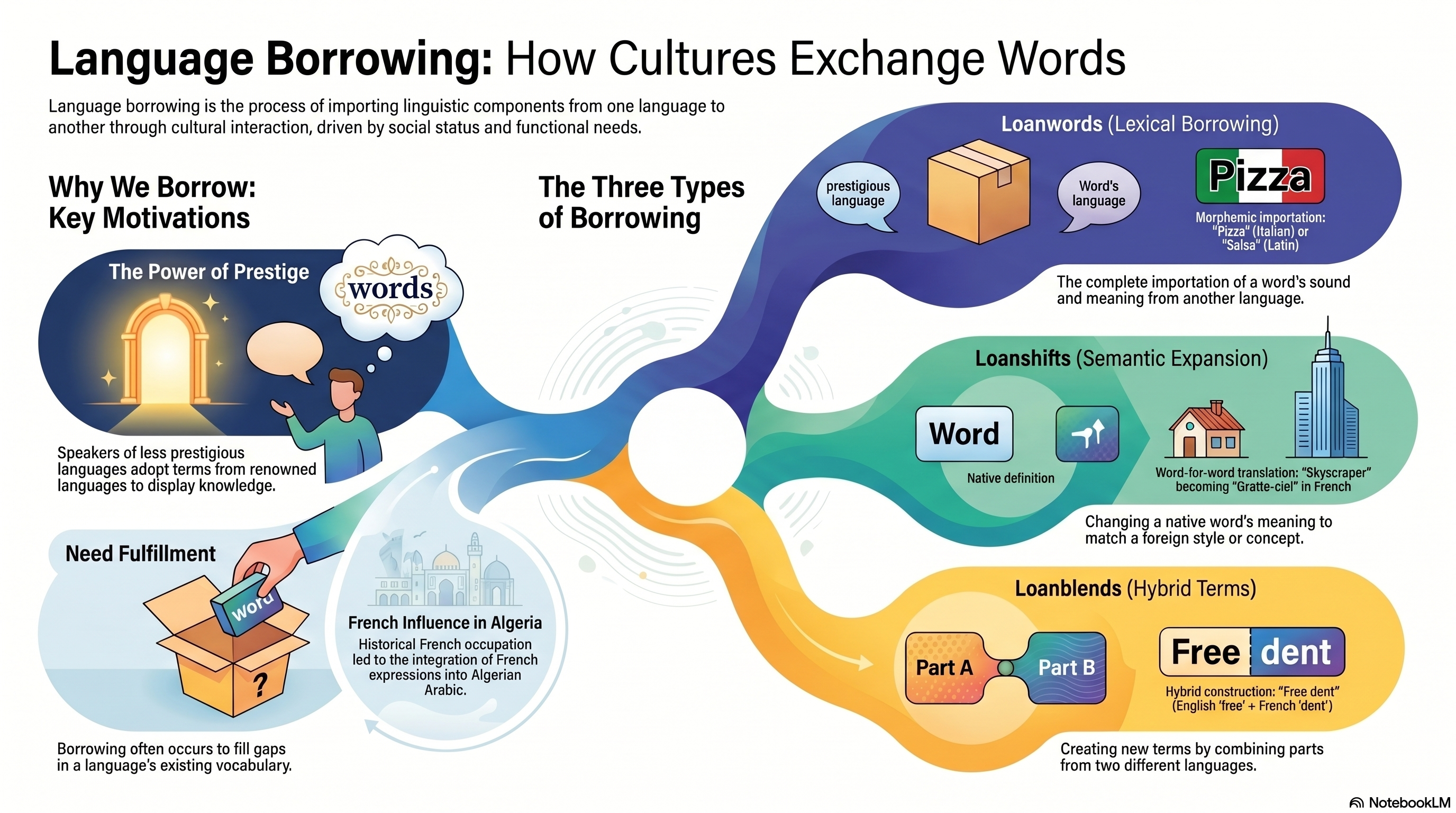
Content-The definition of borrowing and its types
-Borrowing and other linguistic phenomena.
Lesson Five: Pidgin and CreolesObjectives-Understanding pidgins and creoles as products of intense language contact, to distinguish them from other reduced or mixed codes, and to describe their structural and functional characteristics
Content-basic distinctions between Pidgin and creoles-Structural Characteristics of Pidgin and Creole
-Sociolinguistic Status
Lesson 6: GlobalisationObjectives-Understanding the concept of globalisation from different perspectives and disciplines.
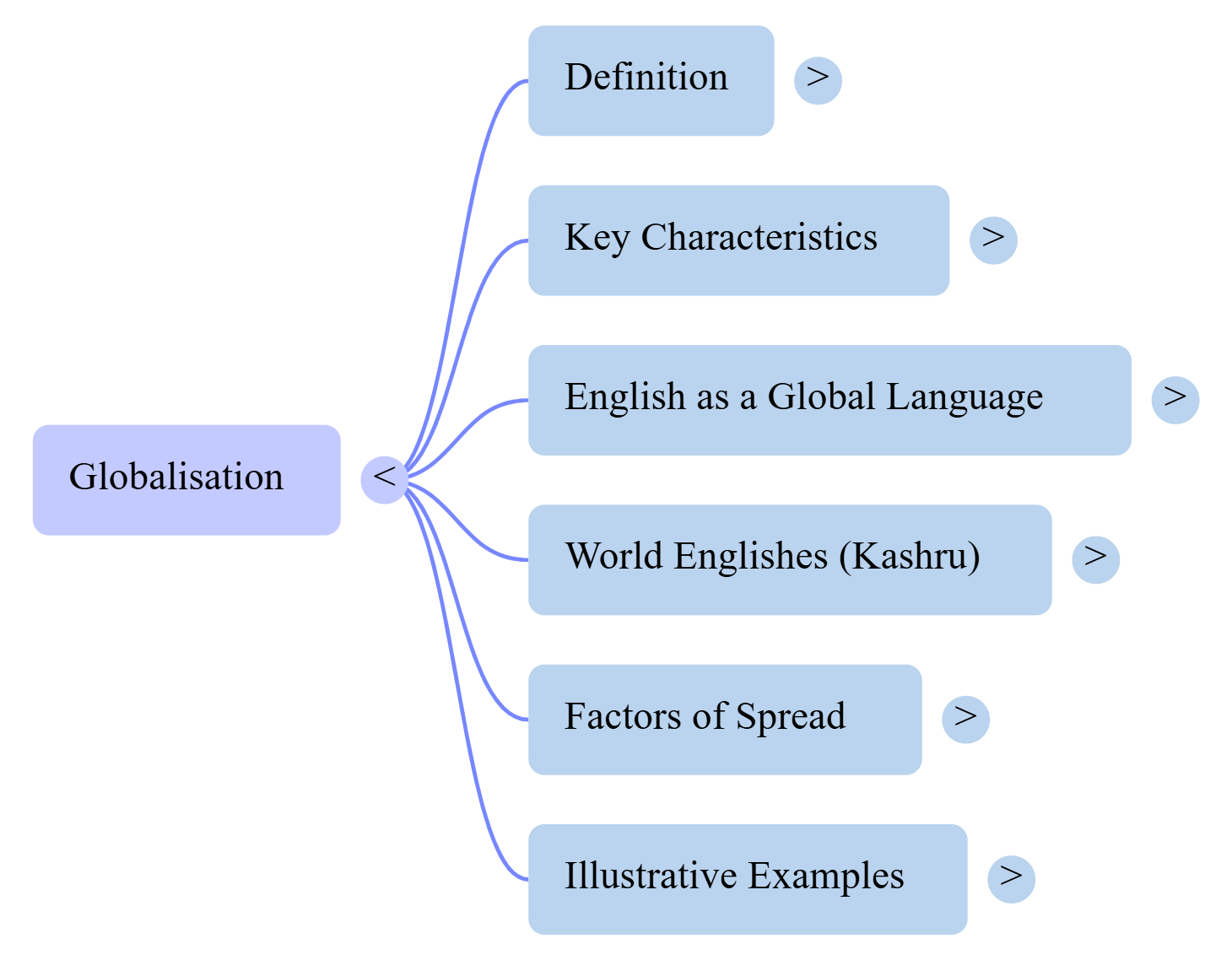
-Discussing the factors of globalisation of English and defining the features of global English.Content-What is Globalisation and English as a Global Language
-World Englishes and the Factors of the Global Spread of EnglishLesson 7: Language PlanningObjectives-Understand what is language planning.
-Distinguish between the different types of language planning.Content-Definition of Language Planning
- Types of Language Planning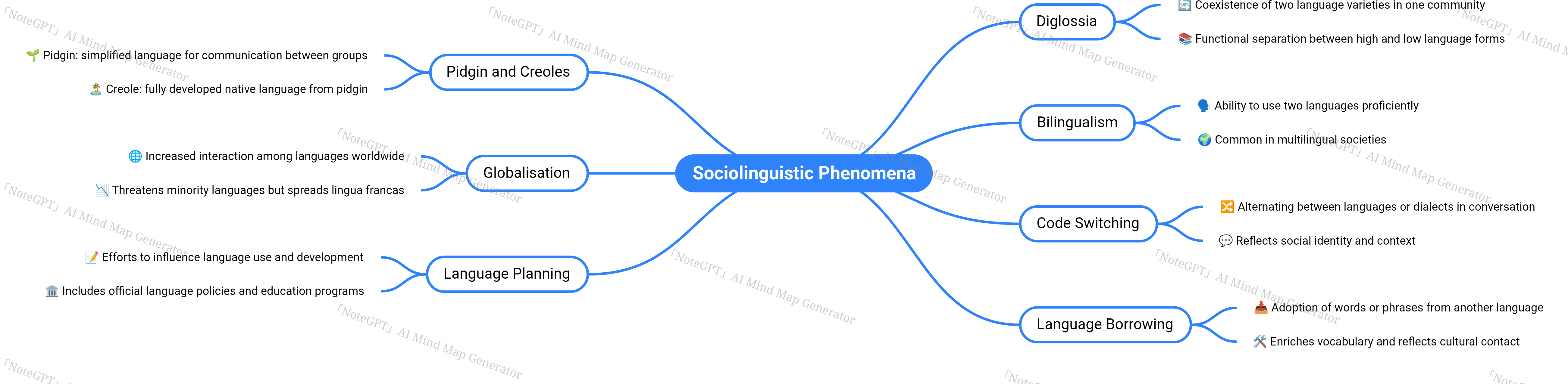
-
This module invites students to explore what happens when different languages and varieties come into
contact in real societies. It uses familiar situations from Algeria and other multilingual contexts to show how phenomena such asdiglossia, bilingualism, code switching, language borrowing, pidgins and creoles, globalisation and language planningshape the way people actually speak and the choices institutions make about languages. Rather than focusing only on theory, the module encourages students to connect these concepts to their own linguistic experiences, to observe language use around them more critically, and to think about the social and political implications of decisions taken in schools, the media and government about which languages and varieties are promoted, tolerated or marginalised-

Students are supposed to meet their teacher via Google meet for any online sessions that are scheduled by the teacher via consulting. In order to participate in online lesson interactions, you click on: https://meet.google.com/oyn-mpus-mrr
-
-
This lesson provides a brief overview of diglossia as a sociolinguistic notion, beginning with Ferguson's classical definition and highlighting the characteristics of H and L varieties through examples from Greek, Arabic, and Tamil. It then provides Fishman's extension to bilingual communities and Fasold's concept of broad diglossia.
Objectives of the course
-
Enabling students to define diglossia and identify High (H) and Low (L) varieties in a given speech community.
-
Helping students describe the functional distribution of H and L varieties across domains (education, religion, home, media, administration, etc.).
-
Developing students’ ability to analyse real examples from their own environment and recognise when and why speakers choose H or L.
-
Encouraging students to discuss the social and educational implications of diglossia, including issues of prestige, stigma, identity, and access to literacy/schooling.
-
Training students to use appropriate sociolinguistic terminology (diglossia, H/L variety, domain, prestige, standard, vernacular) in oral and written work.
-
Fostering critical reflection on language attitudes and language policy in diglossic societies, particularly in their own national/contextual setting.
-
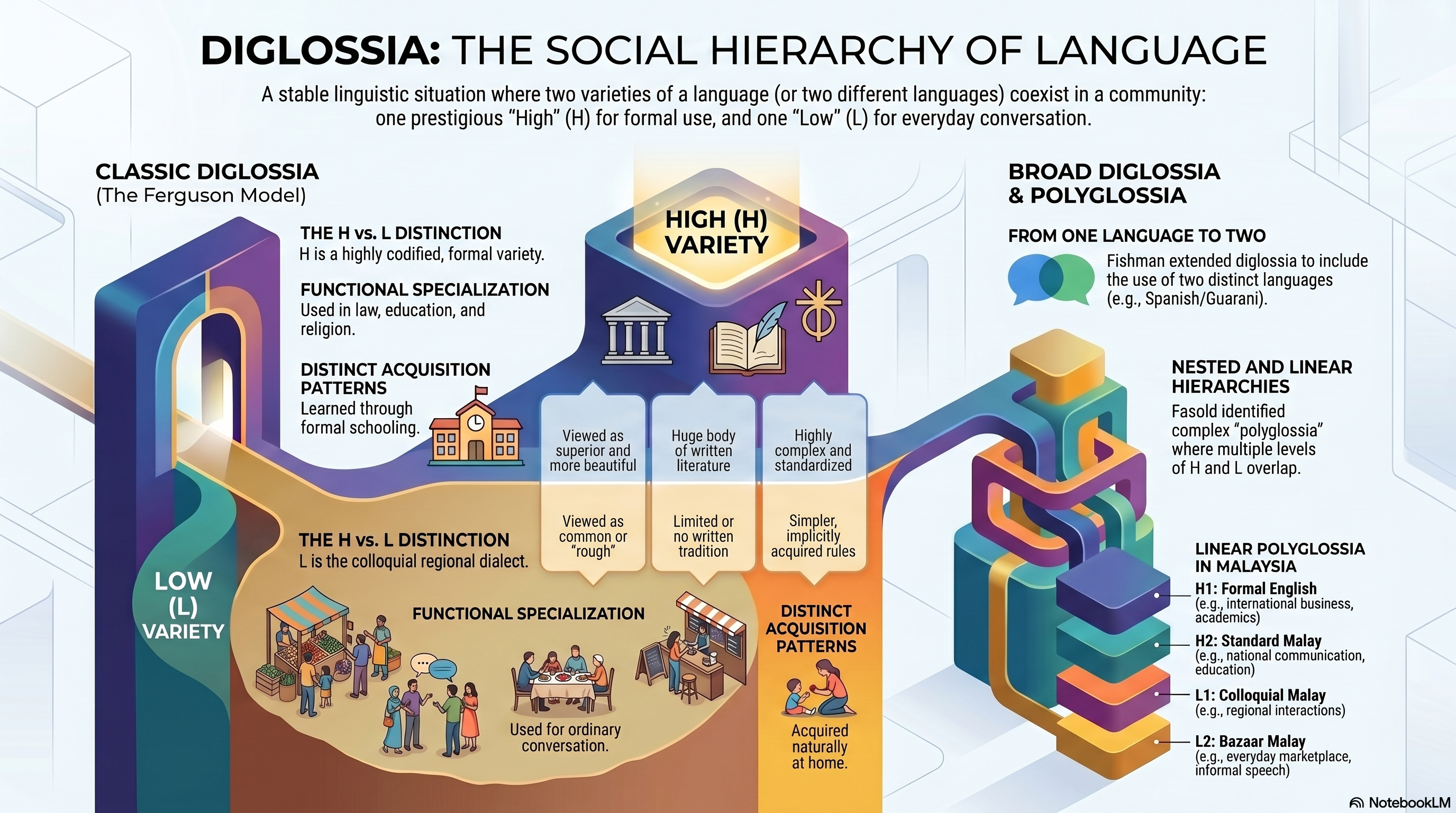

The present file contains information about Diglossia as a sociolinguistic phenomenon. It is crucial to be read by students.
-

Following Fishman's definition, how can you describe the Diglossic situation in Algeria?
-
-
The course introduces students to the phenomenon of using
two languagesbyan individualora community. It presents maindefinitions and types of bilingualism(individual vs societal; balanced vs dominant; early vs late) . The course also encourages students to analyse bilingual practices in their own environment and to reflect critically on common beliefs and attitudes towards bilingual speakers.Objectives
At the end of the course, students will be able to:
-
Define
bilingualismand distinguish it from related notions such asdiglossiaand multilingualism. -
Help students identify
main types of bilingualism(individual vs societal; balanced vs dominant; early vs late; simultaneous vs sequential) and illustrate each with examples. -
Develop students’ ability to describe
bilingual repertoiresand patterns of language use across domains (family, school, administration, media, peer groups) in their own community. -
Train students to
analyse short case studies or profilesof bilingual speakers and classify them according to type and degree of bilingualism, with justified arguments.
-
-
The video highlights the
differencebetween serveraltypes of Bilingualism.-
 This forum is dedicated to the course of Bilingualism. Students might ask their questions, seeking clarification about the course content.
-
-
-
-
The course of
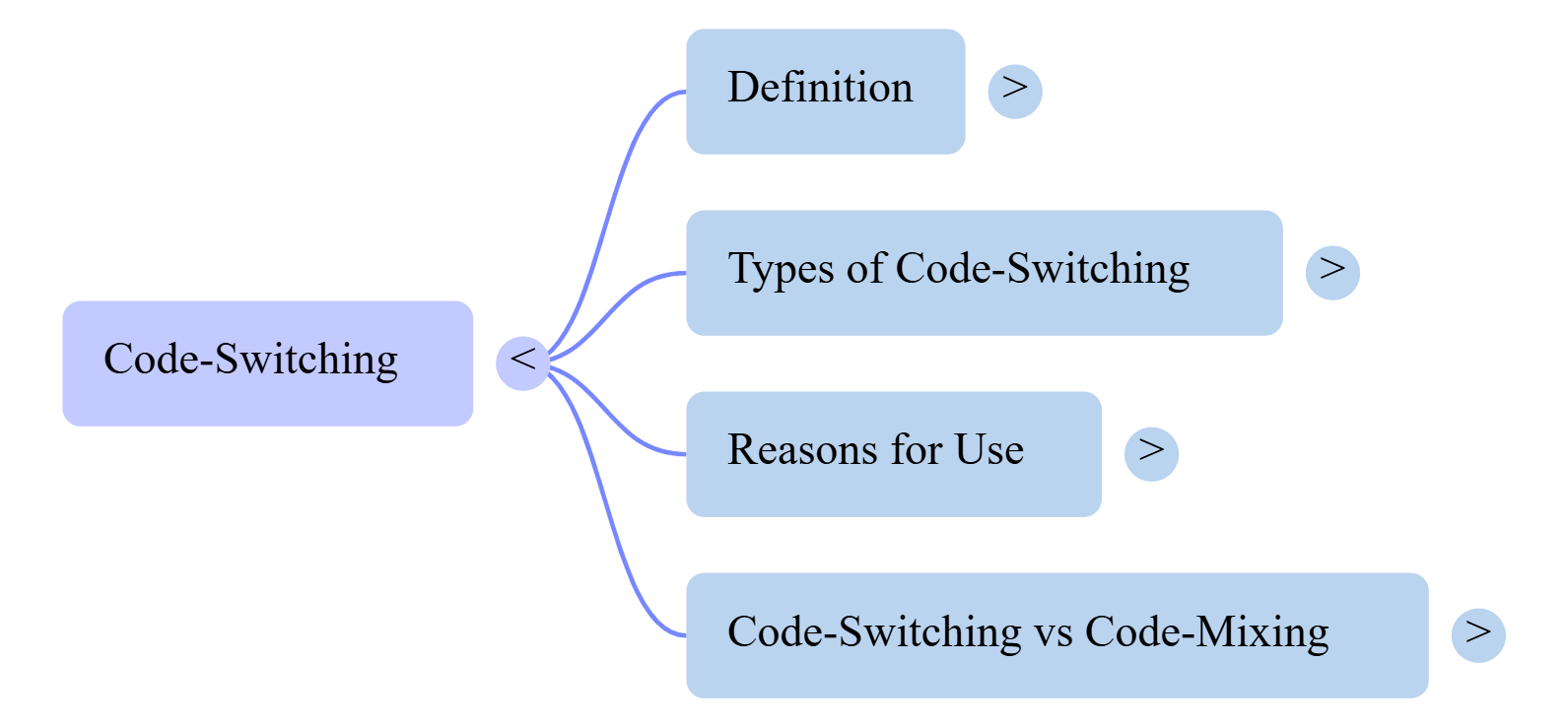
code switchingintroduces students to the phenomenon of alternating between two (or more) languages or varieties within the same interaction, utterance, or discourse. It clarifies howcode switchingdiffers fromcode mixing, outlines its main structuraltypes(inter‑sentential, intra‑sentential, tag switching), and explores thecommunicative and social functionsit fulfils in multilingual communities.Objectives
-
-
-
The present document is helpful for students to have an idea about code switching
-
-
-
-
The video expounds the concept of
Code-Switching and Code-Mixingand theirfunctionsof use. It also explains thedifferencebetween them throughexamples.-
The present forum is attributed to students in order to ask their questions about code-switching. -
-
-
-
-
The course introduces students to the ways in which one language takes words and expressions from another. It explains what borrowing is, how it differs from code switching and code mixing, and the main types of borrowed items.
Objectives
By the end of the course, learners will be able to:
-
Clearly define
language borrowingand distinguish it from code switching and other forms of language contact. -
Identify and classify
different types of borrowings(e.g. loanwords, calques) in authentic examples from their own linguistic environment. -
Describe
how borrowed items are integratedinto the phonological and morphological system of the recipient language. -
Explain
the main reasonswhy speakers use borrowed words (need, prestige, precision, cultural influence, etc.). -
Discuss
the effects of borrowingon vocabulary, language change, and language attitudes in their speech community, using appropriate linguistic terms.
-
-

The present file revolves around the content of the course . It is a reference for students to understand language borrowing
-
-
-

You are asked to answer the questions.
-
-

This forum offers an opportunity for students to ask their questions about language borrowing and its types.
-
-
The course introduces students to contact varieties as outcomes of intense multilingual interaction, especially in colonial and post‑colonial settings. It explains how pidgins arise as simplified contact codes with no native speakers and how some of them develop into creoles, fully‑fledged native languages with their own stable grammar and vocabulary.
ObjectivesBy the end of the course, students will be able to:
-
Define
pidginandcreoleand clearly distinguish them from other contact varieties. -
Describe, in broad terms,
how pidgins arise and how some develop into creolesthrough nativisation and functional expansion. -
Identify
key structural featurestypically associated with pidgins and creoles (e.g. reduced morphology in pidgins, stabilised grammar in creoles). -
Explain the
historical and sociolinguistic contextsin which pidgins and creoles emerge (trade, colonisation, forced labour, migration). -
Discuss the
social status and language attitudessurrounding pidgins and creoles (stigma vs recognition) and their role in identity and education. -
Use appropriate
technical terminologywhen describing examples of pidgin and creole languages in oral and written work.
-
-
The video clarifies the distinction between pidgin and creoles.
-
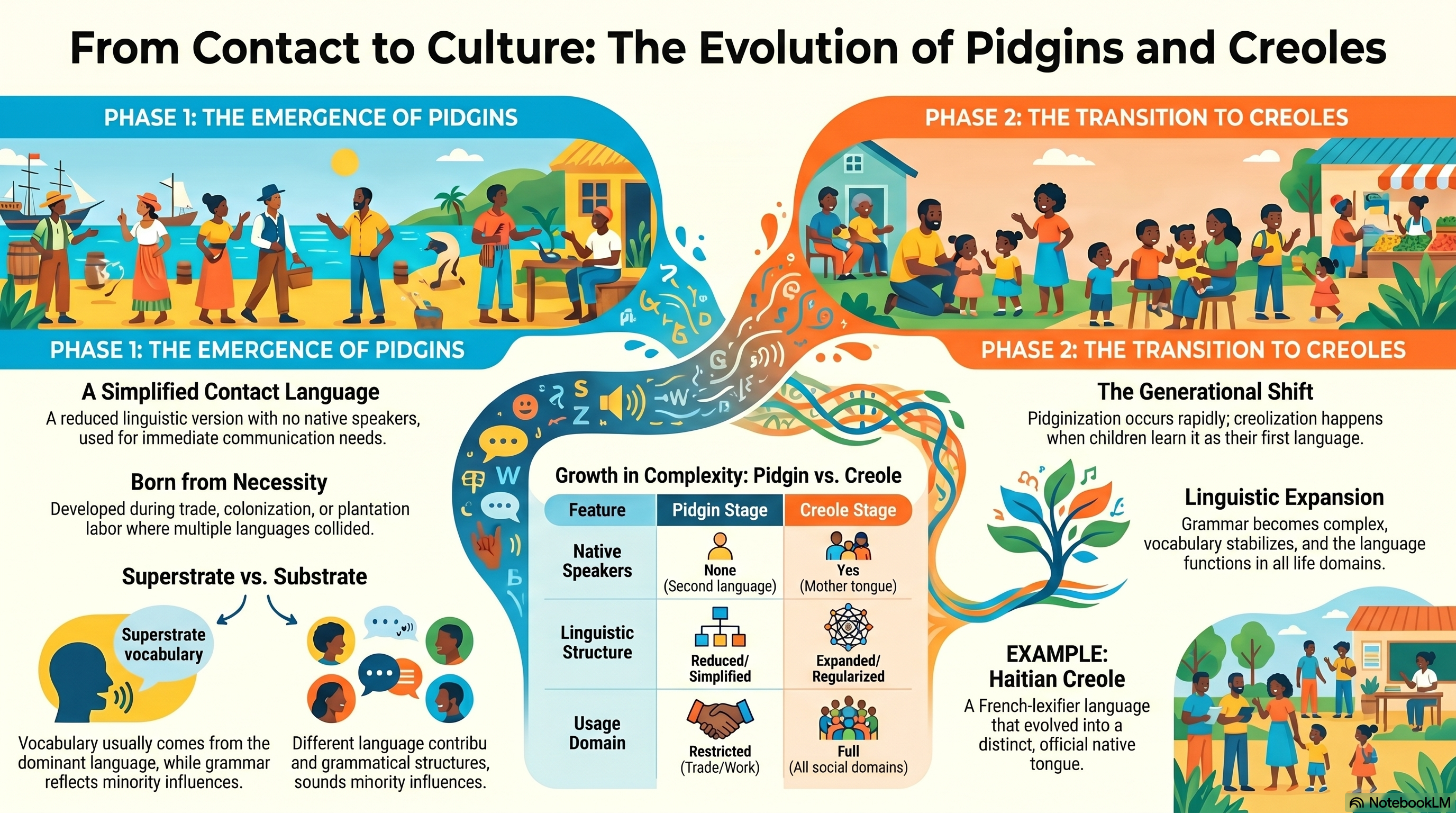 Students are asked to consult the present file to have an idea about Pidgins and Creoles and their historical evolution.
 -

This forum gives a chance to students to seek clarifications from their teachers about Pidgins and Creoles
-
-
-
Students are asked to consult the joint file to answer questions about Pidgins and Creoles
-
-
The course looks at how today’s increasingly connected world shapes the role of English. It starts by clarifying the general idea of globalisation, then shows how English has become a global language with many different varieties around the world. Students are briefly introduced to these World Englishes and to the main reasons English spread so widely.
ObjectivesBy the end of the course, students will be able to:
-
Define
globalisationin simple, relevant terms and relate it to language use. -
Describe why and how
English functions as a global languagein today’s world. -
Recognise that there are multiple
World Englishesand give examples of different varieties. -
Identify the main
factors that contributed to the global spread of English(e.g. colonisation, trade, media, technology). -
Express, in a basic but informed way, some
consequences of English globalisationfor other languages and for speakers’ linguistic identities.
-
-

-
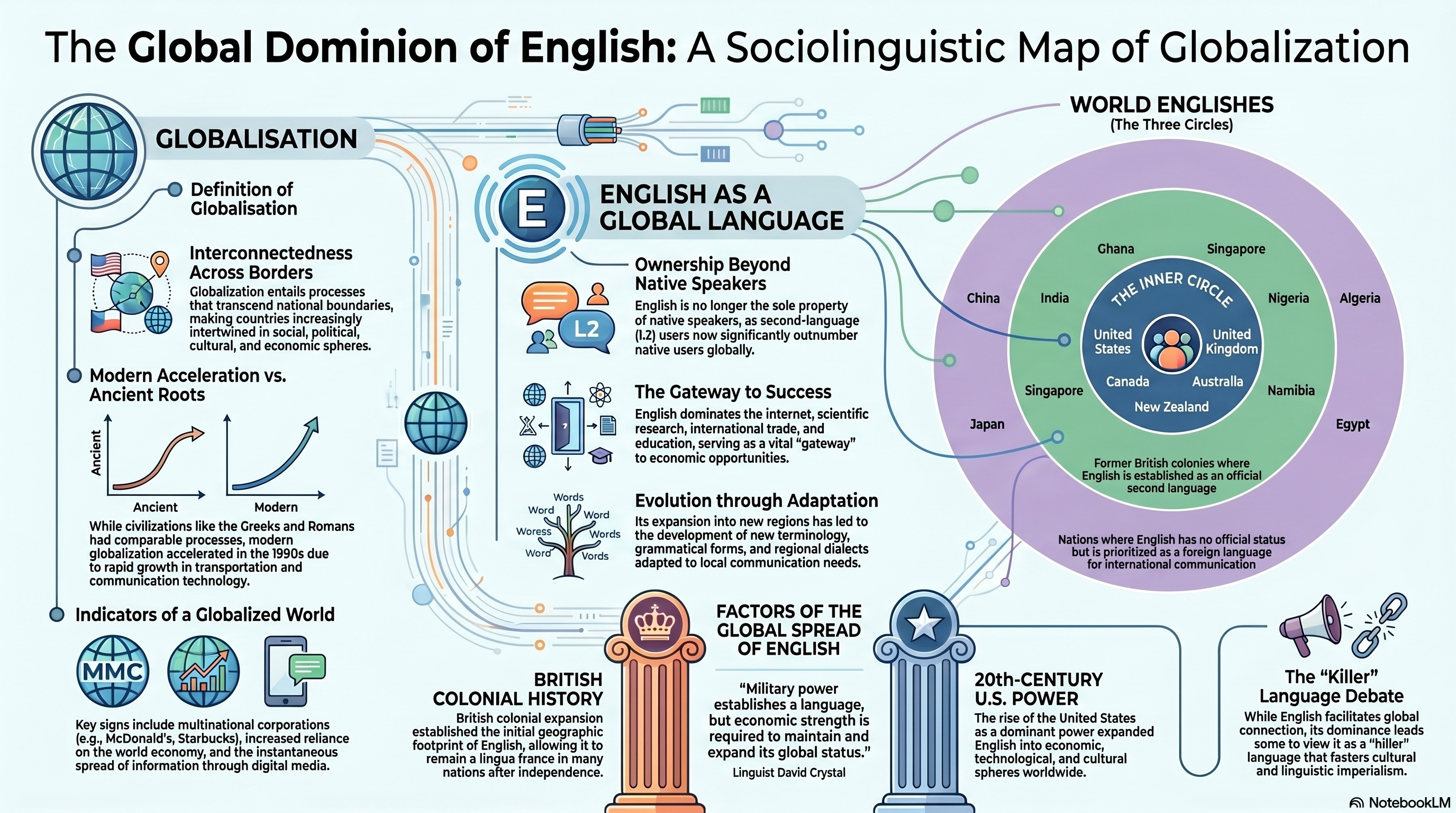
Students are requested to read the file to have an insight about Globalisation and World Englishes
-
-
-
-
The video deals with
the role of English in a globalized world. It also explores how the English language has influenced and been influenced by globalization-

This forum offers an opportunity of students to ask their teacher questions about globalisation and world Eglishes.
-
-
-
-
-
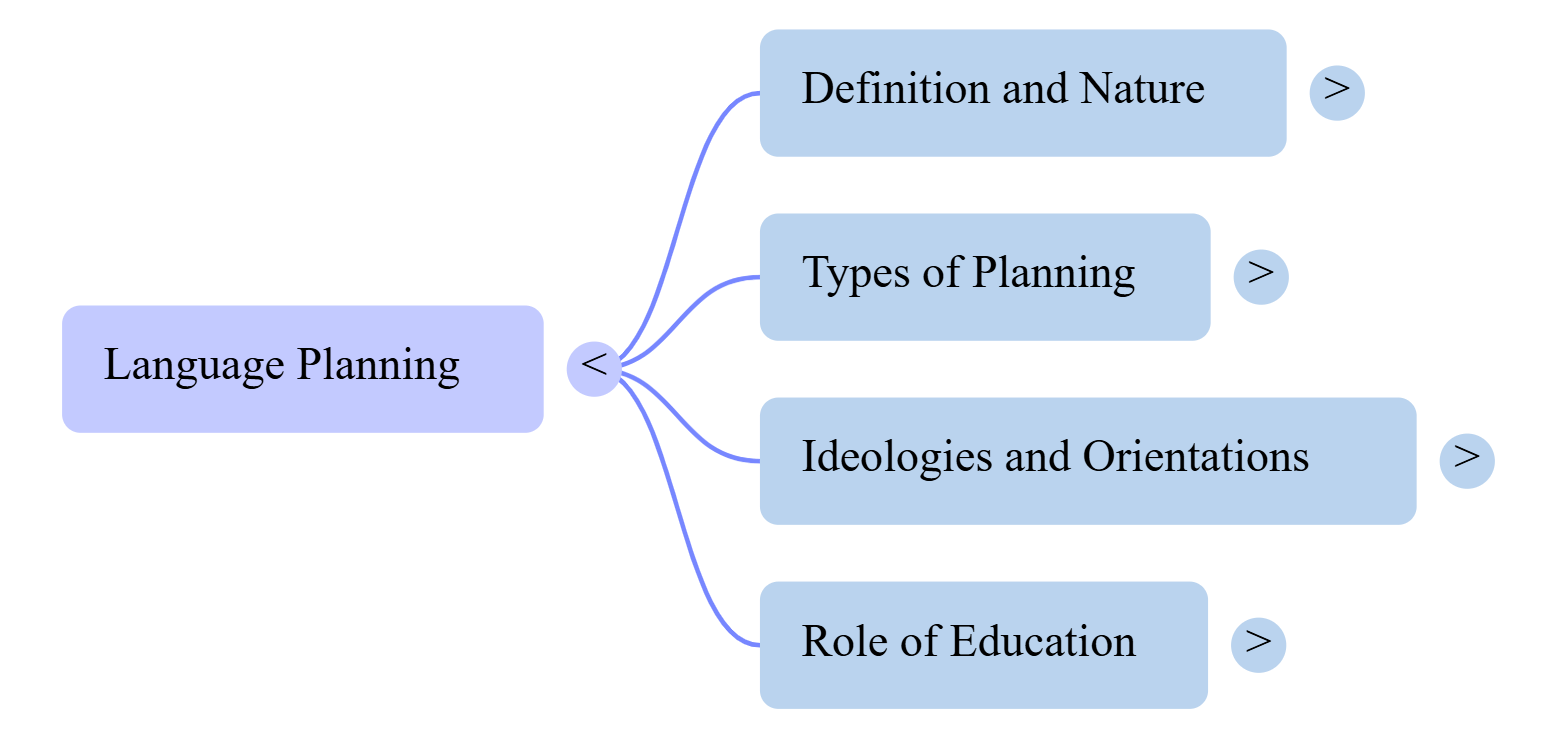
The course introduces the main concepts, types, and practices of organised language management in multilingual societies. It defines language planning, distinguishes between status, corpus, and acquisition planning, and examines the role of language ideologies and orientations in shaping decisions.
ObjectivesBy the end of the course, students should be able to:
-
Define
language planningand situate it within the broader field of sociolinguistics. -
Distinguish between
status, corpus, and acquisition planning, and provide illustrative examples of each. -
Analyse how language ideologies and orientations influence
language planning goalsand decisions. -
Explain the main ways
language planningoperates ineducation, particularly in relation tomedium of instruction and bilingual/ multilingual policies.
-
-

-
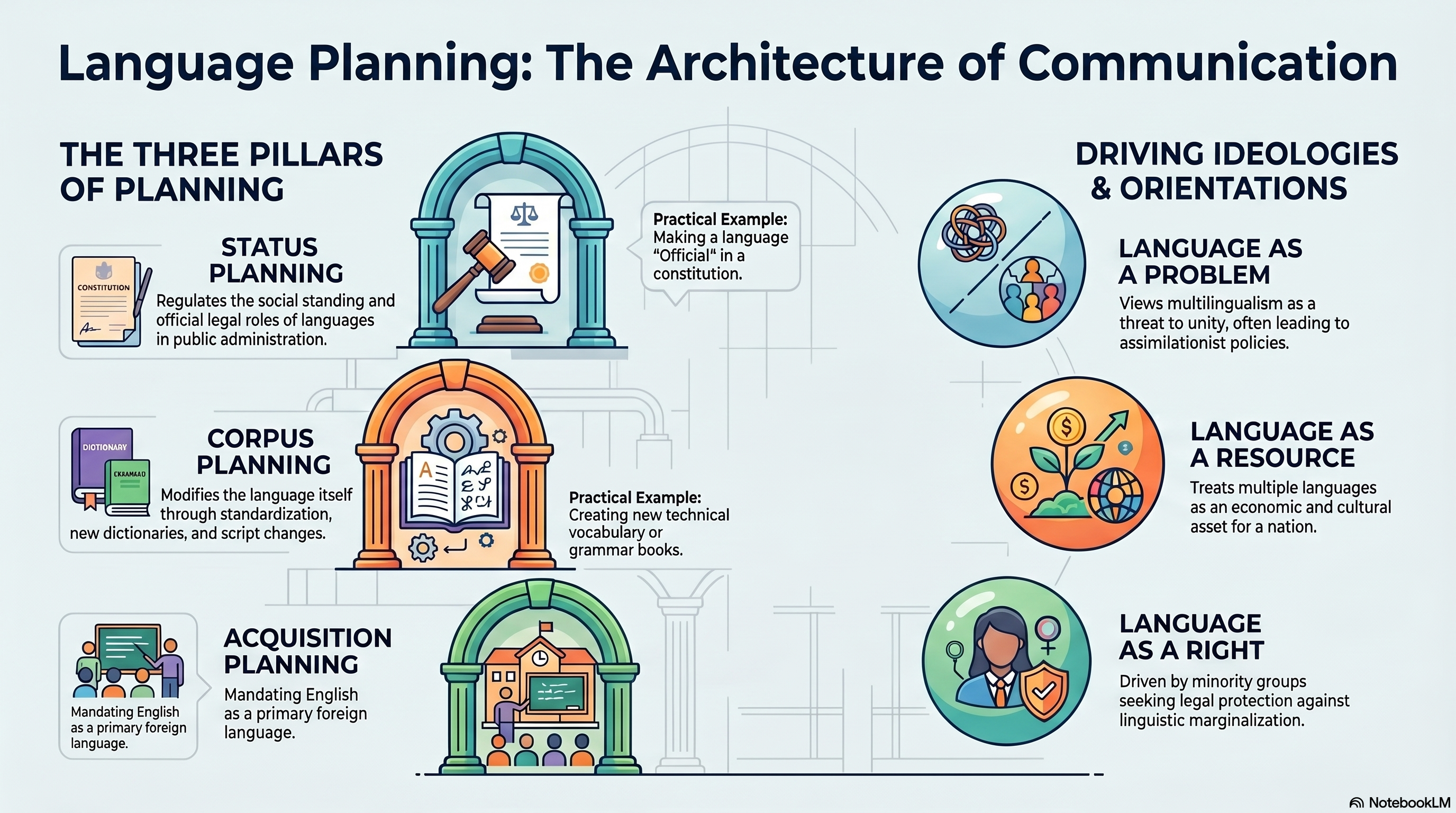
Students are asked to read the file to understand Language Planning and is types -

This forum is constructed for students to ask their own questions about Language planning, seeking for clarification. -

Students are required to answer the questions about Language Planning
-
-
-
-
This exam checks whether students clearly understand what happens when languages come into contact in society: people becoming
bilingual, switchingbetween languages, using different varieties in different situations (diglossia), borrowing words, and creating new contact varieties likepidgins and creoles.It also checks how well students can explain the effects of
globalisationandofficial language policieson which languages are promoted, maintained, or lost.It also evaluates whether the students' aptitude to recognise these phenomena in short examples or case studies (especially from contexts similar to Algeria), name them accurately, and comment on their social causes and consequences using the basic concepts and terms studied in the course.
-
فتحت: الخميس، 30 أبريل 2026، 8:00 AMتستحق: السبت، 2 مايو 2026، 8:00 AM
Ministry of Higher Education and Scientific Research
University of Djilali Bounaama
Department of Foreign Languages
Module: Linguistics
Level:L3
Teacher:Dr. BELKHIR
An Online Exam
Instructions:you should submit your files in a form of pdf.
The file should not exceed two pages in addition to the cover page.
All files that contain identical answers are immediately rejected.
Evaluation Grid:-12points on the content
-6 points on the language
-2 points on the instructions' respect
-
-

List of ReferencesBickerton, D. (1984), The Language Bioprogram Hypothesis, Behavioral and Brain Sciences, 7(2): 173-221.
Crystal, D. (2003), English as a Global Language, Cambridge: Cambridge University Press.
Fasold ,R. (1990), The Sociolinguistics of Language , Blackwell publishers .
Ferguson , C.A (1959a), Diglossia , Word, Vol 15,pp 325-40.
Ferguson, G. (2006). Language Planning and Education. Edinburgh: Edinburgh University Press Ltd.
Fishman, J. A. (1967). Bilingualism with and without Diglossia, Diglossia with and without Bilingualism. Journal of Social Issues. Vol. 23. (p. 29-38).
Fishman, J. A. (1972). The Sociology of Language: An Interdisciplinary Social Science Approach to Language in Society. Massachusetts: Newbury House Publishers.
Gumperz, J. (1982), Discourse Strategies. New York: Cambridge University Press.
Holmes. J. (2008): An Introduction to Sociolinguistics. 3rd edition. Pearson Education Limited
Myers-Scotten, C. (2006): Multiple Voices: An Introduction to Bilingualism. Oxford: Blackwell Publishing.
Poplack, S. (1980), Sometimes l‘ll start a sentence in Spanish y termino en español: Toward o typology of code-switching‖, (581-618) in WEI, Li (2000), Bilingualism Reader, Routledge, 280-297. London, USA, Canada.
Poplack, S. (1981), Syntactic structure and social function of code-switching, in Latino discourse and communicative behavior, R. Duran (ed), New Jersey, Ablex, pp 169- 184.
Poplack, S. (1993) Variation theory and language contact. In Dennis R. PRESTON, American Dialect Research. John Benjamins Publishing Co. Amsterdam/ Philadelphia (251-286)
Wardhaugh, R. (2006). An Introduction to Sociolinguistics (5th ed.). Blackwell: Blackwell Publishing
-

The objective of the remedial activities in this linguistics course is to diagnose and address specific conceptual and analytical gaps in students’ understanding of core linguistic notions and procedures, provide targeted practice with key terminology and representations, and support learners in achieving the stated course outcomes so they can successfully re-engage with regular course tasks and progress with their cohort.
-

Remedial activities in linguistics are structured, extra-support tasks designed to target specific conceptual and analytical weaknesses (revealed by tests, assignments, or classroom performance) so that students can reach the intended learning outcomes of the module and rejoin the regular trajectory of the course
-