
Pidgin and Creoles
Section outline
-
The course introduces students to contact varieties as outcomes of intense multilingual interaction, especially in colonial and post‑colonial settings. It explains how pidgins arise as simplified contact codes with no native speakers and how some of them develop into creoles, fully‑fledged native languages with their own stable grammar and vocabulary.
ObjectivesBy the end of the course, students will be able to:
-
Define
pidginandcreoleand clearly distinguish them from other contact varieties. -
Describe, in broad terms,
how pidgins arise and how some develop into creolesthrough nativisation and functional expansion. -
Identify
key structural featurestypically associated with pidgins and creoles (e.g. reduced morphology in pidgins, stabilised grammar in creoles). -
Explain the
historical and sociolinguistic contextsin which pidgins and creoles emerge (trade, colonisation, forced labour, migration). -
Discuss the
social status and language attitudessurrounding pidgins and creoles (stigma vs recognition) and their role in identity and education. -
Use appropriate
technical terminologywhen describing examples of pidgin and creole languages in oral and written work.
-
-
The video clarifies the distinction between pidgin and creoles.
-
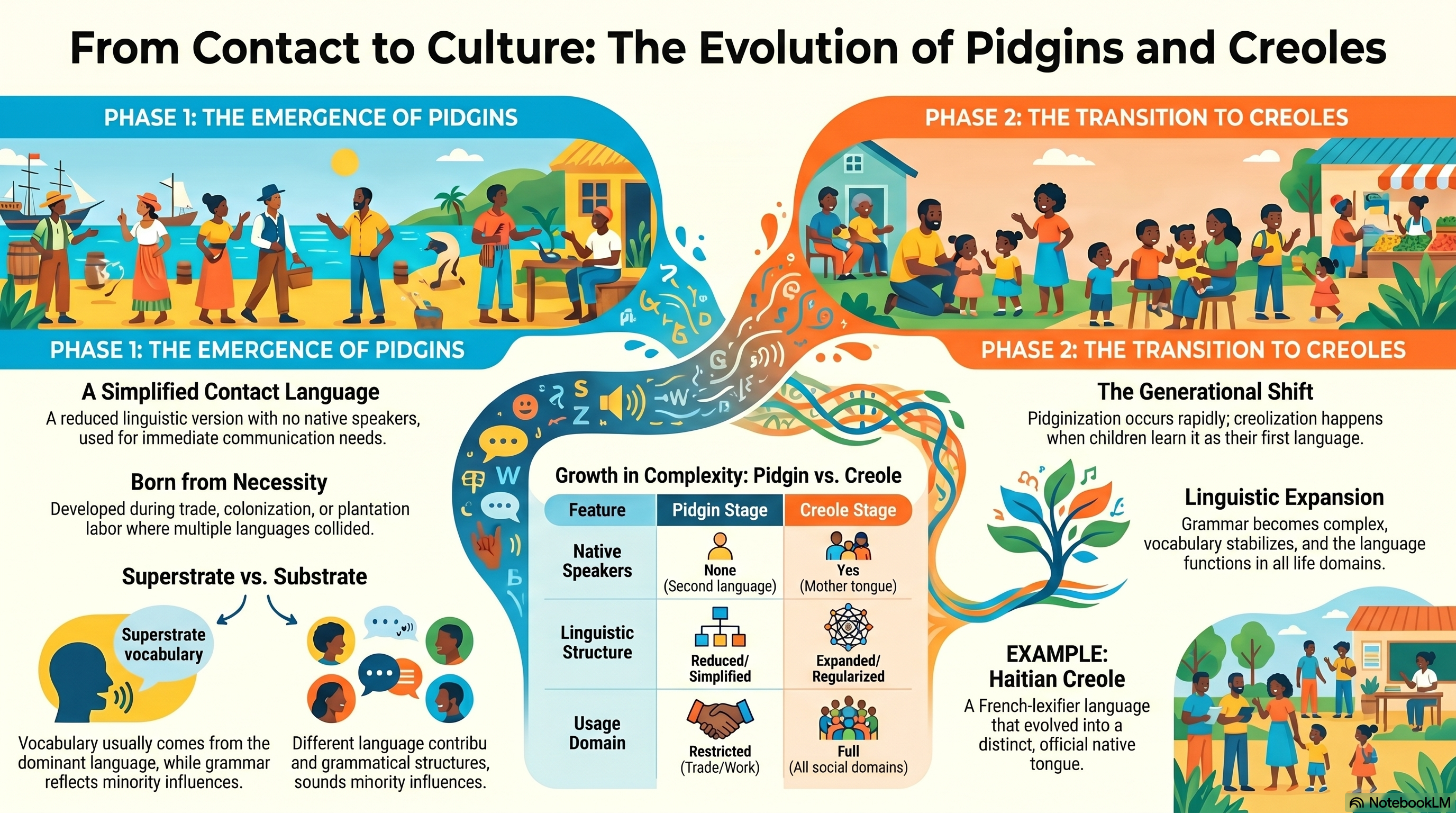 Students are asked to consult the present file to have an idea about Pidgins and Creoles and their historical evolution.
 -

This forum gives a chance to students to seek clarifications from their teachers about Pidgins and Creoles
-
-
-
Students are asked to consult the joint file to answer questions about Pidgins and Creoles
-
