Mecanique des Fluides
Section outline
-
University: Djilali Bounaama Khemis Miliana
Faculty: Science and Technology
Department: Material Sciences
Domain: Sciences and technology
Level: L2_Physics
Module: Fluid Mechanics.
Semester: 02 (15 weeks).
Coefficient: 04
Credit : 02
Semester hourly volume: 45h00.
Weekly hourly volume: 03h00 min (01h50 min lessons and 1h30 min tutorial)
Lecturer: Dr. ELBAA Mohamed.
specialty: Materials Physics
Diploma: Doctor in Materials Physics
Grade: MCB
Contact: m.elbaa@univ-dbkm.dz.
Assessment method: The evaluation is carried out through a Continuous assessment and a Final Exam (Continuous assessment: 33% and Final exam: 67%). To pass the module, the general average must be greater than or equal to 10 out of 20.
-

The objectives of studying fluid dynamics are to understand the fundamental principles governing fluid motion, analyze flow behavior under various conditions, develop mathematical models to predict fluid interactions, apply these concepts to engineering and environmental systems, optimize designs for efficiency and performance, and advance research in aerodynamics, hydraulics, and related fields.
-
Study fluid dynamics, you should have a strong foundation in the following areas:
Mathematics – Calculus (differential, integral, vector), differential equations, linear algebra, and tensor analysis.
Physics – Newtonian mechanics, thermodynamics, and basic knowledge of waves and oscillations.
Classical Mechanics – Understanding of forces, motion, and conservation laws (mass, momentum, energy).
Fluid Statics & Basics – Pressure, buoyancy, viscosity, and fluid properties (density, compressibility,...).
advanced topics).
A strong grasp of these topics will help in understanding fluid flow equations (Navier-Stokes, Bernoulli’s) and their applications in aerodynamics, hydraulics, and more. -
Chapter 1: Generalities
Definition of the continuous medium, characteristic of the fluid medium, notion of fluid particle. Volume forces and surface forces applied to a fluid domain. Perfect fluid, viscous fluid.Chapter 2: Fluid Statics
General equation of fluid statics. Special case of hydrostatics. Archimedes' thrust forces. Gas Statics.
Chapter 3: Fluid kinematics
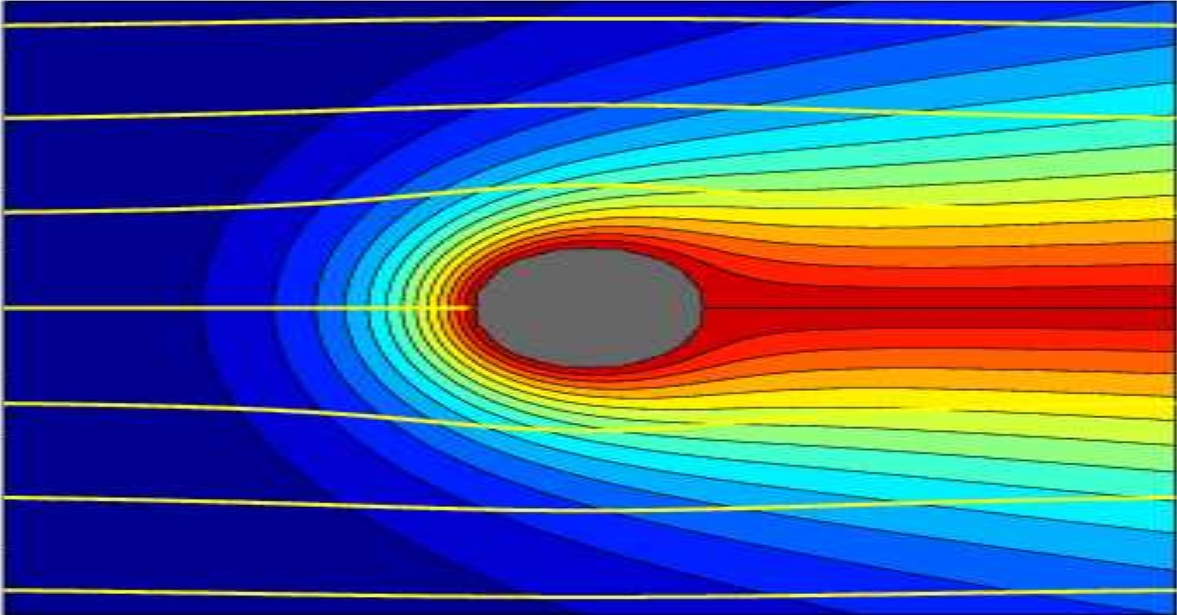
Locating a fluid particle. Lagrange's point of view, Euler's point of view, particle derivative. Streamlines, emission line, trajectory. Tensor of deformations laws of behavior. Case of a Newtonian fluid. Rotational and irrotational flows. Planar flows with velocity potential: classic example.
Chapter 4: Perfect Fluid Dynamics
General theorems. Fundamental equations for a perfect fluid. Bernoulli's equation: applications. Study of flow meters (venture, Pitot tube…).
Chapter 5: Viscous Fluid Dynamics
Integral equation of motion. Local equation, Navier-Stockes equation, applications Solving some classical unsteady problems.
Chapter 6: Introduction to Gas Dynamics
St-Venant's barre equation. Flow in a convergent-divergent. Supersonic flow, shock waves.