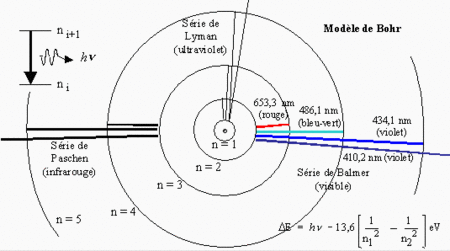
Quantum Chemistry II
Résumé de section
-
University: Djilali Bounaama Khemis Miliana
Faculty: Faculty of Matter Sciences and Computer Science
Department: Matter Sciences Department
Specialty: Chemistry
Level: Third Year Bachelor's Degree (Licence)
Module: Quantum Chemistry II
Semester: 02
Credits: 05
Unit: Fundamental
Coefficient: 3
Class schedule: 1 hour 30 minutes, 3 sessions per week (1 lecture and 1 tutorial)
Classroom: Sunday (lecture, Room 30) / (Tutorial, Room 30)Course Instructor: Dr. Fizir Meriem
Specialty: Pharmaceutical Analysis
Degree: Doctor in Pharmaceutical Analysis
Academic Rank: MCA (Senior Lecturer/Associate Professor, Class A)Contact: You can contact me at meriem.fizir@univ-dbkm.dz starting at 6:00 PM (evening).
Assessment Method:
The final evaluation is carried out through:-
Tutorial assessment: Represents 33% of the final grade (12 points from quizzes, 5 points for attendance, and 3 points for participation).
-
Final written exam: Counts for 67% of the final grade and covers all the material you have seen in this course during the semester.
To pass the module, the overall average must be greater than or equal to 10 out of 20.
-
-
Learning Objectives
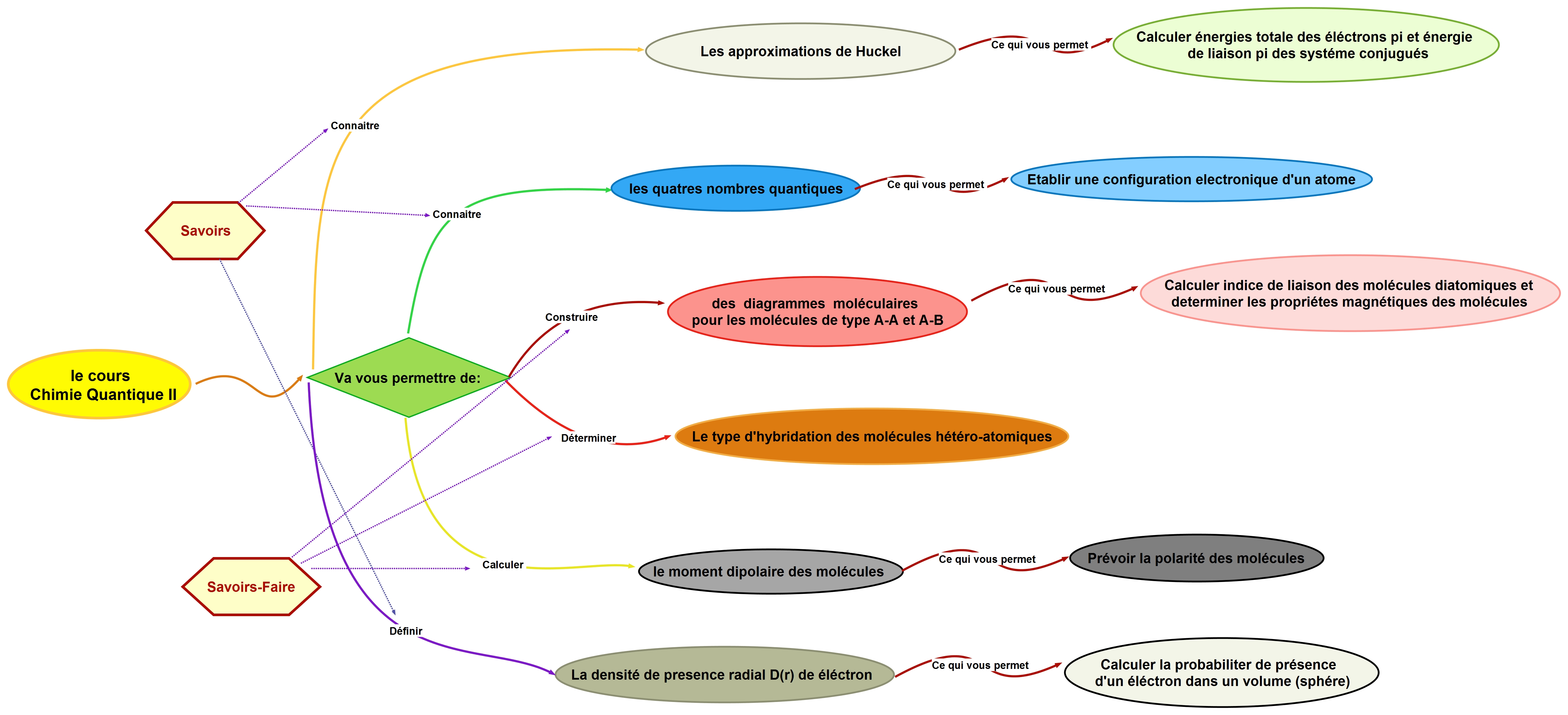
Upon completion of this course, the student will be able to:
-
Understand the electronic behavior of molecules.
-
Calculate the energies of atomic orbitals for different atoms.
-
Analyze the emission spectra of various chemical species.
-
Interpret the properties of chemical species using quantum mechanics concepts.
-
Identify the types of hybridization in different molecules.
-
Differentiate between polar and non‑polar molecules.
-
Calculate the probability of electron presence within a given volume (sphere).
-
Determine the molecular orbital energies of π electrons in conjugated hydrocarbon systems.
-
-
-
To progress smoothly through the concepts presented in this course and get the most out of it, you need to know:
-
The nuclear composition of atoms.
-
The types of chemical bonds in molecules (sigma and pi bonds).
-
Basic mathematics: trigonometry, solving equations of different degrees, integrals and derivatives of mathematical functions.
-
-
-
L
Quantum chemistry is a branch of theoretical chemistry that applies the principles of quantum mechanics to molecular systems in order to study chemical processes and properties.
The electronic and nuclear behavior of molecules, being responsible for chemical properties, can only be adequately described by the quantum equation of motion (Schrödinger equation) and the other fundamental postulates of quantum mechanics. This need has motivated the development of concepts (notably the molecular orbital) and numerical calculation methods that have enabled modern chemistry to make considerable progress, both in understanding phenomena and in their applications.
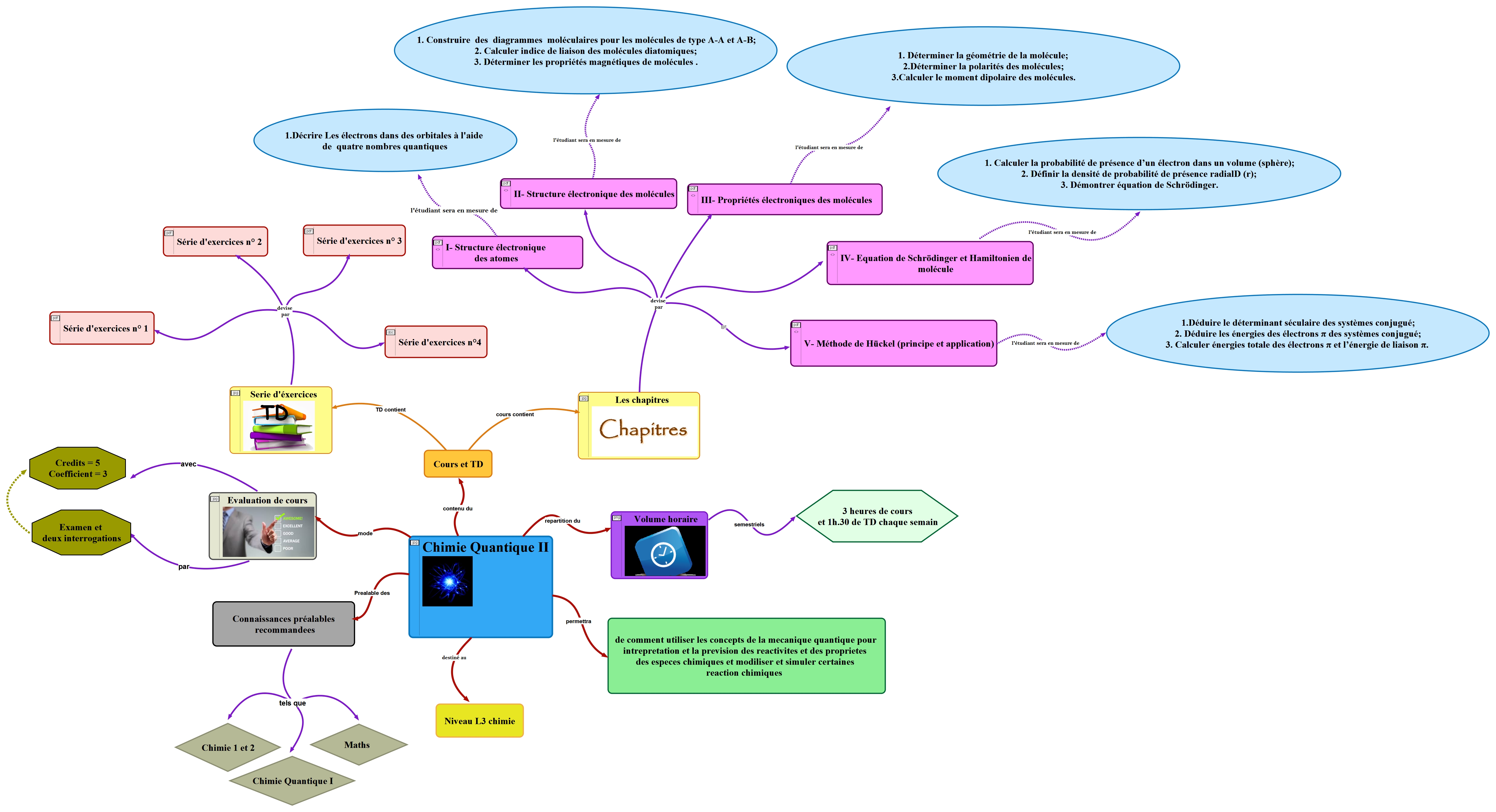
This course contains 5 chapters:
-
Chapter I: Electronic structure of atoms
-
Chapter II: Electronic structure of molecules
-
Chapter III: Electronic properties of molecules
-
Chapter IV: Schrödinger equation and molecular Hamiltonian
-
Chapter V: Hückel method (principle and application)
These chapters are presented progressively so that students can adapt to this new learning method. The theoretical course is reinforced by in-class assessment exercises and exercise sets solved during tutorial sessions. Students are also directed to online learning resources, such as online courses or more detailed explanatory videos.
-
-
By the end of this chapter, students will be able to:
-
Construct molecular diagrams for A‑A and A‑B type molecules
-
Calculate the bond order of diatomic molecules
-
Determine the magnetic properties of homo‑ and heteronuclear diatomic molecules
-
Determine the hybridization type of hetero‑atomic molecules
The two prerequisites necessary for understanding this second chapter are:
-
The electronic configuration of atoms (see Chapter I)
-
The geometry of atomic orbitals (see Chapter I)
-
-
Bibliographie
- Introduction à la chimie quantique : Claude Leforestier. Edition Dunod; 2005.
- Élément de Chimie quantique à l'usage des chimistes ( 2éme édition) : Jean-Louis Rivail. Edition : EDP Sciences; 1999
- B.VIDAL, Chimie Quantique, ED. Masson, 1992.
- D. Mac QUARRIE, I,D,SIMON, Chimie physique : approche moléculaire, Ed, Dunod, 2000.
- P. HIBERTY,N?T.ANH,Introduction à la chimie quantique, Ed. Ecole Polytechnique, 2008.
- C. LEFORESTIER, Introduction à la chimie quantique, Cours et exercices corriges, Ed. Dunod, 2005.
- Structure électronique des molécules. Géométrie, réactivité et méthode de Hückel - Structure électronique des molécules cours et exercices corrigés. De Yves Jean, François Volatron Dunod.1994.
- Hückel théorie pour les Chimistes organiques, C. A. Coulson, B. O'Leary et R. B. Mallion, Academic Press, 1978.
- Utilisation de la théorie des orbitales moléculaires Huckel dans l'interprétation des spectres visible de Teintures polyméthine: Une expérience de premier cycle chimie physique, D. Bahnick, A. J. Chem. Educ. 1994, 71, 171.
- Hückel théorie et la spectroscopie photoélectronique, E. vonNagy-Felsobuki, I. J. Chem. Educ. 1989, 66, 821.