لغة أجنبية
Section outline
-
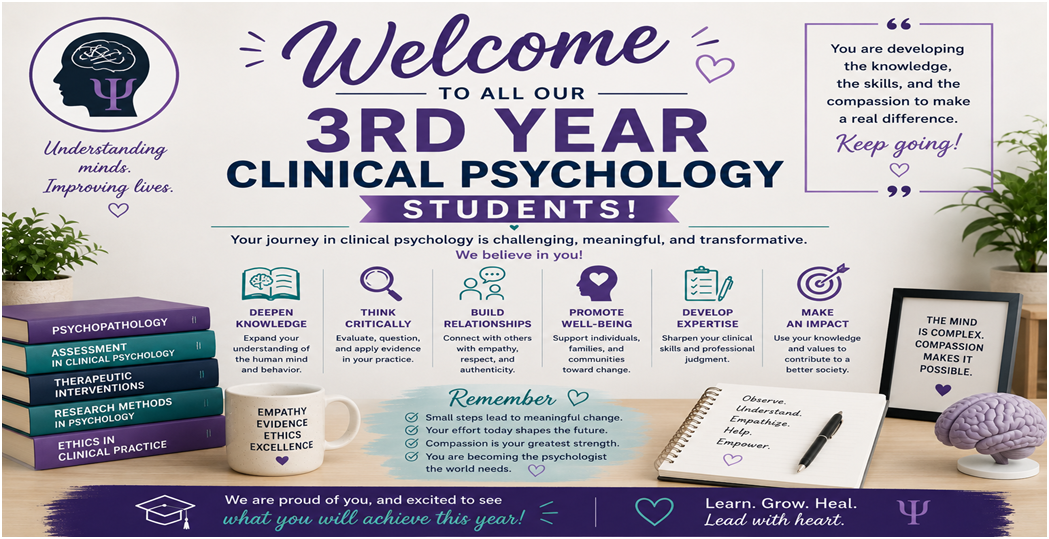
Dear Students, Welcome to our third-year course in Clinical Psychology. I am delighted to have you in this class as we explore some of the most important topics in abnormal psychology, including the nature of psychological disorders and the major approaches used to explain and treat them. This module will challenge you to think critically, apply theory to real clinical situations, and deepen your understanding of how evidence-based practice shapes modern mental health care. I look forward to an engaging and productive semester together. Wishing you all motivation, curiosity, and success as we begin this learning journey.
Warm regards
, [Dr Mezaini]
-
Module: English for Clinical Psychology
Welcome to English for Clinical Psychology module for the first semester of the 2025–2026 academic year. This course introduces students to major concepts in abnormal psychology, with a focus on defining abnormality and understanding the nature, causes, and treatment of phobias, depression, and obsessive–compulsive disorder (OCD). Through lectures, case studies, and guided discussions, students will develop strong conceptual and analytical skills essential for advanced clinical practice and research.
This course aims to:
- Introduce students to the foundations of abnormal behavior and criteria used to define psychological disorders.
- Provide an in-depth understanding of phobias, depression, and OCD, including their symptoms and diagnostic features.
- Explore behavioural, cognitive, and biological approaches to explaining psychopathology.
- Examine evidence-based treatments aligned with each theoretical model.
- Develop students’ abilities to analyze case studies and apply theoretical frameworks to clinical examples.
- Strengthen critical thinking skills necessary for evaluating research and clinical interventions.
- Prepare students for advanced coursework and professional training in psychological assessment and intervention.
-
Course Description
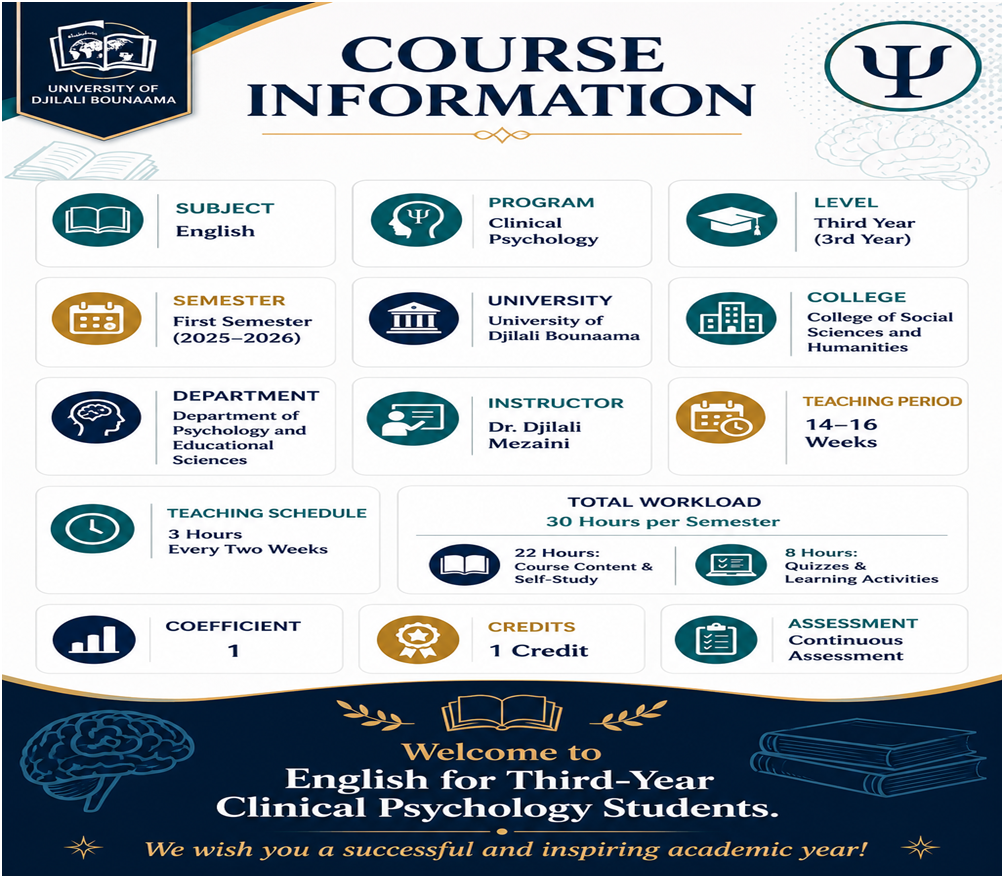
This English course is designed for third-year undergraduate students in Clinical Psychology. It aims to develop students' academic English proficiency while strengthening the language skills required for psychological studies, professional communication, and scientific reading. Throughout the semester, students will acquire discipline-specific vocabulary, improve their reading comprehension, enhance their academic writing, and develop effective oral communication skills relevant to psychology and mental health.
The course is delivered over 14–16 weeks with 3 hours of instruction every two weeks, for a total workload of 30 hours per semester. This includes 22 hours devoted to studying course materials and assimilating new knowledge, and 8 hours allocated to quizzes, learning activities, and self-assessment exercises that reinforce understanding and facilitate learning.
Course Requirements
Students are expected to:
- Study all learning materials provided in each module.
- Participate actively in discussion forums and learning activities.
- Complete all quizzes and self-assessment exercises.
- Review feedback to improve their performance.
- Complete the final assessment at the end of the semester.
Participation in discussion forums and learning activities forms an essential component of the learning process and contributes to students' engagement with the course content.
Assessment
Assessment is based on continuous evaluation throughout the semester.
At the end of each module, students will complete a practice quiz consisting of 10–20 multiple-choice questions (MCQs) designed to assess their understanding of the lesson content.
Upon successful completion of all learning modules, activities, and quizzes, students will gain access to a comprehensive final examination consisting of 20 multiple-choice questions covering all course topics.
To successfully complete the course, students must achieve a minimum score of 50%. Multiple attempts may be permitted according to the course platform settings, allowing students to improve their performance and reinforce their learning.
-
-
-
Opened: Thursday, 2 October 2025, 12:00 AMDue: Thursday, 9 October 2025, 12:00 AM
-
-
-
-
Opened: Wednesday, 30 September 2026, 6:23 PMCloses: Sunday, 20 December 2026, 6:23 PM
-
Opened: Wednesday, 30 September 2026, 11:17 PMCloses: Saturday, 19 December 2026, 10:01 PM
-
Opened: Wednesday, 30 September 2026, 11:18 PMCloses: Saturday, 19 December 2026, 10:24 PM
-
Opened: Wednesday, 30 September 2026, 11:18 PMCloses: Sunday, 20 December 2026, 10:30 PM
-
Opened: Wednesday, 30 September 2026, 11:06 PMCloses: Saturday, 19 December 2026, 11:06 PM
-
Opened: Wednesday, 30 September 2026, 11:07 PMCloses: Saturday, 19 December 2026, 11:07 PM
-
-
-
-
Opened: Thursday, 1 October 2026, 5:23 PMCloses: Saturday, 19 December 2026, 4:44 PM
-
Opened: Thursday, 1 October 2026, 5:14 PMCloses: Saturday, 19 December 2026, 5:14 PM
-
Opened: Thursday, 1 October 2026, 5:24 PMCloses: Saturday, 19 December 2026, 5:24 PM
-
-
-
Opened: Thursday, 1 October 2026, 5:37 PMCloses: Saturday, 19 December 2026, 5:37 PM
-
Opened: Thursday, 1 October 2026, 5:47 PMCloses: Saturday, 19 December 2026, 5:47 PM
-
Opened: Thursday, 1 October 2026, 6:03 PMCloses: Saturday, 19 December 2026, 6:03 PM
-
Opened: Thursday, 1 October 2026, 6:23 PMCloses: Saturday, 19 December 2026, 6:23 PM
-
-
-
References

American Psychiatric Association. (2022). Diagnostic and statistical manual of mental disorders (5th ed., text rev.; DSM-5-TR). American Psychiatric Association Publishing.
Barlow, D. H., & Durand, V. M. (2024). Abnormal psychology: An integrative approach (9th ed.). Cengage Learning.
Beck, A. T., Davis, D. D., & Freeman, A. (2015). Cognitive therapy of personality disorders (3rd ed.). Guilford Press.
Butcher, J. N., Hooley, J. M., & Mineka, S. (2022). Abnormal psychology (18th ed.). Pearson.
Carlat, D. J. (2024). The psychiatric interview (5th ed.). Wolters Kluwer.
Comer, R. J., & Comer, J. S. (2024). Fundamentals of abnormal psychology (11th ed.). Worth Publishers.
Fairburn, C. G. (2008). Cognitive behavior therapy and eating disorders. Guilford Press.
Kaplan, H. I., Sadock, B. J., & Ruiz, P. (2023). Kaplan & Sadock's synopsis of psychiatry: Behavioral sciences/clinical psychiatry (12th ed.). Wolters Kluwer.
Kring, A. M., Johnson, S. L., Davison, G. C., & Neale, J. M. (2023). Abnormal psychology (15th ed.). Wiley.
Levenson, J. L. (Ed.). (2024). The American Psychiatric Association publishing textbook of psychosomatic medicine and consultation-liaison psychiatry (4th ed.). American Psychiatric Association Publishing.
Morrison, J. (2024). DSM-5-TR® made easy: The clinician's guide to diagnosis (2nd ed.). Guilford Press.
National Institute for Health and Care Excellence. (2022). Depression in adults: Treatment and management (NICE Guideline NG222). https://www.nice.org.uk/guidance/ng222
National Institute for Health and Care Excellence. (2024). Generalised anxiety disorder and panic disorder in adults: Management (Clinical Guideline CG113). https://www.nice.org.uk/guidance/cg113
Sadock, B. J., Sadock, V. A., & Ruiz, P. (2023). Kaplan & Sadock's comprehensive textbook of psychiatry (11th ed.). Wolters Kluwer.
Van der Kolk, B. A. (2015). The body keeps the score: Brain, mind, and body in the healing of trauma. Penguin Books.
World Health Organization. (2022). International classification of diseases 11th revision (ICD-11): Clinical descriptions and diagnostic requirements for mental, behavioural and neurodevelopmental disorders. World Health Organization.
-
-