
Chimie 2
Section outline
-

Teacher: BOUKHATEM Horiya
Email: h.boukhatem@univ-dbkm.dz
Department: Chemistry
Teaching Unit: Fundamental Teaching Unit
Subject: Chemistry 2/ Thermodynamics & Chemical Kinetics
Coefficient: 03
Credits: 06
Assessment Method: Continuous Assessment: 33%, Exam: 67%
-

Chapter 1: Overview of Thermodynamics
Chapter 2: First Principle of Thermodynamics
Chapter 3: Application of the First Principle of Thermodynamics to Thermochemistry
Chapter 4: Second Principle of Thermodynamics
Chapter 5: Free Energy and Enthalpy – Criteria for the Evolution of a System
-

These "Chemistry 2" courses are intended for first-year undergraduate students (L1) in Material Sciences. The course is composed of six chapters.
The first chapter introduces the fundamental concepts and initial definitions used in thermodynamics, the ideal gas laws, and the statement of the zeroeth law of thermodynamics.
The second chapter elaborates on the different forms of energy (work and heat), their transfers, and the statement of the first law of thermodynamics.
The third chapter is dedicated to thermochemistry and the application of the first law of thermodynamics to chemical reactions.
The fourth chapter presents the second law of thermodynamics, various expressions of entropy, the statement of the third law of thermodynamics, and heat engines.
The fifth chapter introduces enthalpy and free energy, as well as the criteria for the evolution of chemical equilibria.
The sixth and final chapter develops the main kinetic factors influencing the rate of chemical reactions and the different methods for determining the order of a reaction.
-

To progress in these courses, prior knowledge of secondary education is necessary.
It is also recommended to have a mastery of S1 mathematics.

-


Objectives of Chapter 1
By the end of this chapter, students should be able to:
1. Define basic thermodynamic concepts
2. Understand state functions and their properties
3. Apply the ideal gas law and related principles
4. Work with temperature and pressure scales
5. State the Zeroth Law of Thermodynamics
6. Apply sign conventions
-

By the end of this chapter, students should be able to:
1. Understand and calculate work in thermodynamic systems
2. Define and quantify heat transfer
3. Calculate heat transfer for different thermodynamic processes
4. State and apply the First Law of Thermodynamics
5. Compute changes in internal energy and enthalpy
-
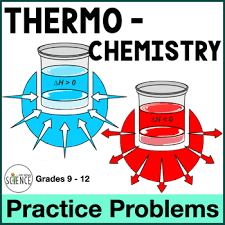

By the end of this chapter, students should be able to:
1. Introduce the concepts of standard state and standard enthalpy of formation (ΔHf∘)
2. Calculate enthalpy changes
3. Apply Hess’s Law
4. Understand and calculate bond enthalpies from experimental data.
5. Apply Kirchhoff’s Law to determine how reaction enthalpy changes with temperature
-


By the end of this chapter, students should be able to:
1. Define entropy (S)
2. State the Second Law of Thermodynamics
3. Calculate entropy changes for different processes
4. Calculate entropy changes during phase transitions
5. Apply Hess’s Law to calculate entropy changes of chemical reactions
6. Use Kirchhoff’s Law for entropy to determine ΔSRΔSR at different temperatures
7. State the Third Law of Thermodynamics
-


The main objectives of the chapter:
1. Define and understand the thermodynamic functions : Helmholtz free energy and Gibbs free energy
2. Interpret the sign of ΔG as a criterion for spontaneity and equilibrium
3. Calculate ΔG°R for chemical reactions
4. Define chemical equilibrium and introduce the mass action laws
5. Understand and apply the Van’t Hoff equation to study the temperature dependence of equilibrium constants
6. State and apply Le Chatelier’s principle to predict shifts in equilibrium due to changes in:Temperature, Total pressure, Partial pressure/concentration, Addition of inert gases
-

The main objectives of the chapter:
1. Understand and apply the rate law
2. Analyze the influence of concentration on reaction rate for different reaction orders
3. µUnderstand the effect of temperature on reaction rate
4. Apply methods to determine reaction order
5. Interpret graphical representations of kinetic data (linear plots for different orders, Arrhenius plots, energy diagrams).
-

[1] P. Amiot ; « Thermodynamique », Université Laval, Québec, Canada, 2006.
[2] B. Fosset ; « Chimie, Tout-En-Un • PSI-PSI*, Cours et exercices corrigés », Dunod, Paris, 2008. [3] G. Faverjon ; « Les nouveaux précis Bréal, Thermodynamique MPSI », 2003.
[4] R. Ouargli-Saker ; « Cours de thermodynamique » ; Université Mohamed Boudiaf-Oran, 2015-2016.
[5] H. Maghat ; « Thermochimie/Equilibres chimiques », Université Moulay Ismail-Meknès, 2017-2018.
[6] S. Nouri ; «Thermodynamique - Résumé de cours et exercices corrigés » ; Université Houari Boumediene-Alger, 2019-2020.
[7] M. A. Oturan, M. Robert ; « Thermodynamique chimique »; Presses universitaires de Grenoble, 1997.
[8] C. Vanhaverbeke ; « Chapitre 1 : Cinétique chimique » ; Université Joseph Fourier de Grenoble, 2011-2012.