
Chapter 2 — Concepts of Heat Transfer Modes
Section outline
-
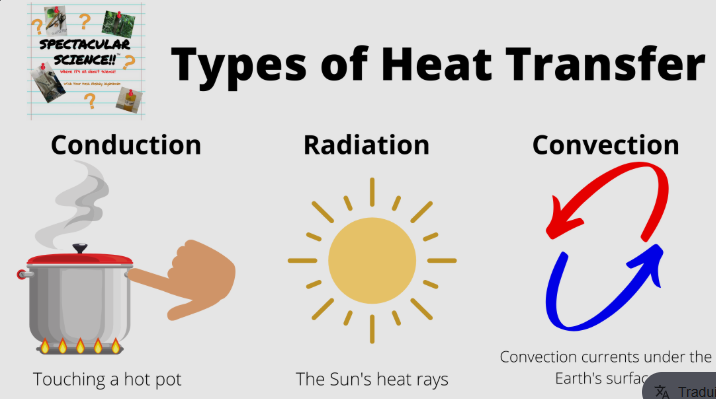
Heat transfer occurs through three fundamental modes:
1. Conduction – Transfer of heat through direct contact between particles within a solid or between touching objects, without bulk movement of the material. Energy passes from faster (hotter) vibrating molecules to slower (cooler) ones. Example: a metal spoon heating up in hot soup.
2. Convection – Transfer of heat through the movement of fluids (liquids or gases). Warmer fluid rises, cooler fluid sinks, creating circulation currents. It can be natural (driven by density differences) or forced (driven by fans or pumps). Example: boiling water or sea breezes.
3. Radiation – Transfer of heat via electromagnetic waves, requiring no medium—it works even through a vacuum. All objects emit thermal radiation, with hotter objects emitting more. Example: heat from the Sun reaching Earth, or warmth from a fire.
In practice, all three modes often work together—for instance, a radiator heats a room by conduction (through its walls), convection (warming the air), and radiation (emitting infrared waves).