
Chapter 6 — Chemical Potential
Section outline
-
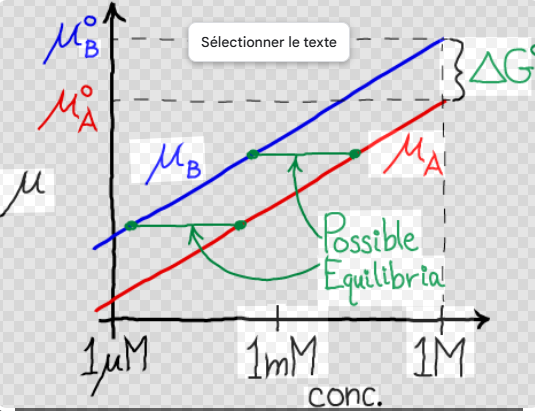
Chemical potential is a thermodynamic quantity that measures how much the energy of a system changes when the number of particles in it changes, while keeping entropy, volume, and other conditions fixed.
In simple terms, it tells you the "energy cost" of adding one more particle to a system. It is denoted by the Greek letter μ (mu) and is especially important when a system can exchange particles with its surroundings, or when different phases or chemical species are in contact.
Key points:
-
Definition: μ = (∂G/∂N) at constant temperature and pressure, where G is Gibbs free energy and N is the number of particles.
-
Physical meaning: Particles tend to move from regions of high chemical potential to low chemical potential — just as heat flows from high to low temperature.
-
Role in equilibrium: A system is in equilibrium when the chemical potential of each species is the same in every phase or region.
-
Applications: It governs phase transitions, chemical reactions, diffusion, and phenomena like osmosis.
-