
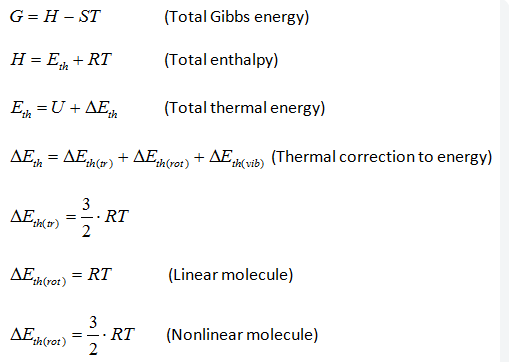
Thermodynamic functions (also called state functions) are quantities that describe the state of a thermodynamic system, depending only on its current condition—not on how it got there. Common examples include internal energy (U), enthalpy (H), entropy (S), Gibbs free energy (G), and Helmholtz free energy (A). They are used to predict whether processes occur spontaneously, to calculate energy changes, and to relate heat, work, and equilibrium in physical and chemical systems.