لغة أجنبية
Section outline
-

Dear students,
It gives me great pleasure to welcome you to your second year in the Speech–Language Pathology program. I hope this new academic year brings you motivation, curiosity, and confidence as you continue your journey in understanding human communication and its disorders.
During the first semester, our main objective will be to help you build a solid foundational understanding of the major communication, speech, voice, fluency, and sound disorders that you will encounter in your future clinical practice. By the end of the semester, you should be able to identify, describe, and explain the nature, signs, symptoms, and causes of the most common communication disorders.
I look forward to working with all of you throughout this semester. May it be a year filled with learning, engagement, and growth.
Welcome once again—and let’s begin this exciting journey together!Warm regards,
[D.MEZAINI] -
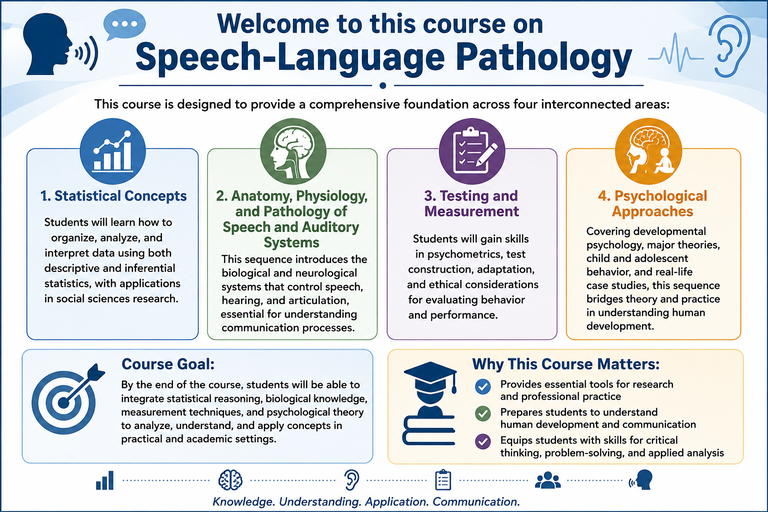
Welcome to this course on Speech-Language Pathology. This course is designed to provide a comprehensive foundation across four interconnected areas:
- Statistical Concepts – Students will learn how to organize, analyze, and interpret data using both descriptive and inferential statistics, with applications in social sciences research.
- Anatomy, Physiology, and Pathology of Speech and Auditory Systems – This sequence introduces the biological and neurological systems that control speech, hearing, and articulation, essential for understanding communication processes.
- Testing and Measurement – Students will gain skills in psychometrics, test construction, adaptation, and ethical considerations for evaluating behavior and performance.
- Psychological Approaches – Covering developmental psychology, major theories, child and adolescent behavior, and real-life case studies, this sequence bridges theory and practice in understanding human development.
Course Goal:
By the end of the course, students will be able to integrate statistical reasoning, biological knowledge, measurement techniques, and psychological theory to analyze, understand, and apply concepts in practical and academic settings.Why This Course Matters:
- Provides essential tools for research and professional practice
- Prepares students to understand human development and communication
- Equips students with skills for critical thinking, problem-solving, and applied analysis
-
Hello everyone, and welcome to our course forum for Communication, Speech, Voice, and Sound Disorders! I am delighted to accompany you throughout this semester as we explore the foundations of human communication and the disorders that can affect speech, fluency, voice, and sound production.
This forum will be your space to:
-
Ask questions about course content
-
Share insights or reflections from class
-
Discuss examples or cases related to communication disorders
-
Support one another in understanding key concepts
Feel free to participate actively—your ideas and questions will enrich our learning experience.
I look forward to working with each of you and helping you build a strong foundation in Speech–Language Pathology.
Let’s make this s -
-
General Objectives
General Objectives
- Develop foundational knowledge of statistical concepts in a foreign language, including both descriptive and inferential statistics.
- Enhance understanding of key statistical measures, such as mean, median, and standard deviation, and their applications in research.
- Build basic competencies in research methodology, including measurement principles, test construction, and adaptation in the social sciences.
- Acquire fundamental knowledge of human anatomy and physiology, particularly the phonatory and auditory systems, and their related pathologies.
- Understand the structure and function of the nervous system, including both central and peripheral components.
- Develop a solid grounding in psychological theories and schools of thought, with emphasis on their historical and conceptual foundations.
- Gain insight into developmental psychology, focusing on child and adolescent development.
- Apply theoretical knowledge to practical situations through the analysis of case studies.
- Strengthen academic and professional communication skills in a foreign language across different subject areas.
- Promote integrative learning through comprehensive reviews of training modules.
-
-
-
Opened: Wednesday, 1 October 2025, 12:00 AMDue: Monday, 20 October 2025, 12:00 AM

Course: Speech and Language Pathology / Communication Disorders
Quiz Type: Diagnostic (Not graded or low stakes)
Purpose: To assess whether students possess the foundational knowledge needed for the course.
-
-
-
-
-
-
SEQUENCE TWO: Introduction to the anatomy, physiology, and pathology of the phonatory and auditory systems.
-
Learning Outcomes
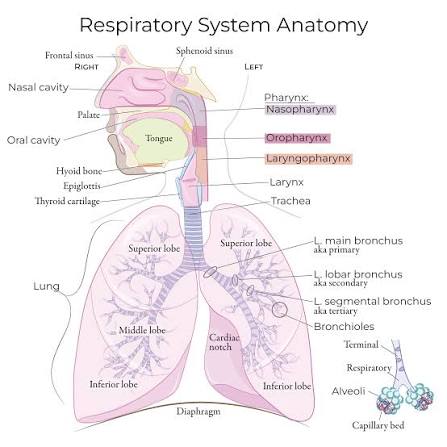
By the end of this lecture, students will be able to:
- Identify the key anatomical structures involved in respiration relevant to speech, including lungs, diaphragm, trachea, bronchi, and alveoli.
- Explain the physiological mechanisms of inhalation and exhalation, highlighting differences between quiet breathing and speech breathing (e.g., 50/50 vs. 10/90 ratios).
- Describe the role of the bony skeletal framework (vertebral column, rib cage, pectoral and pelvic girdles) in supporting respiration for speech.
- Analyze the impact of respiratory disorders (e.g., COPD, asthma, neuromuscular disease) on voice quality, loudness, and phrase length.
- Apply respiratory knowledge in clinical assessment and intervention, including observation, functional tests (maximum phonation time, syllable repetition), and pulmonary function measurements.
-
Learning Objectives
By the end of this chapter, students should be able to:
- Identify the anatomical location of the larynx and hyoid bone.
- Describe the skeletal framework of the larynx, including unpaired and paired cartilages.
- Explain the function and attachment of intrinsic and extrinsic laryngeal membranes.
- Identify and classify laryngeal muscles and their role in phonation.
- Describe the structure and divisions of the internal cavity of the larynx.
- Relate laryngeal anatomy to phonatory function, vocal fold motion, and speech production.
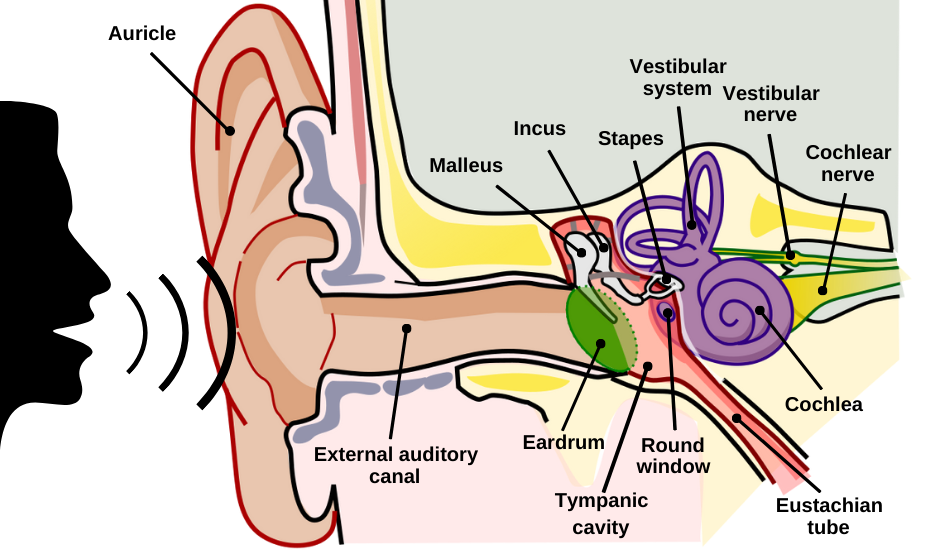
- Identify the key auditory structures involved in hearing and their role in speech perception.
- Correlate structural and functional abnormalities with common voice and hearing disorders.
- Apply clinical reasoning to case scenarios involving phonatory and auditory dysfunction.
-
Lesson Outline
- Introduction
- The Articulatory System
- Skeletal Framework of Articulation
- Muscular Framework of Articulation
- The Major Articulators
- Active and Passive Articulators
- Coordination of Articulation During Speech
- Clinical Applications in Speech-Language Pathology
- Essential Vocabulary
- Practical Activities
- Summary
- Review Questions
-
-
-
-
-
Lesson Outline
- Introduction
- Why Use Case Studies?
- Case Study 1: Language Delay
- Case Study 2: Autism Spectrum Disorder
- Case Study 3: Stuttering
- Case Study 4: Adolescent Social Communication
- Case Study 5: Child with Hearing Loss
- Integrating Developmental Theories into Clinical Practice
- Essential Vocabulary
- Practical Activities
- Summary
- Review Questions
-
-
-
-
Opened: Tuesday, 30 December 2025, 8:48 PMClosed: Sunday, 25 January 2026, 11:59 PM
-
-