
الانجليزية الاقتصادية العامة
Section outline
-
-

Djilali Bounaama University – Khemis Miliana
Faculty of Economics, Commerce and Management Sciences
Department of Economic SciencesSpecialization: Economic Sciences
Level: Second Year – LicenceSemester: Third
Teaching Unit: Fundamental/ Complementary language course
Course: General Economic English
Credits: 01
Coefficient: 01
Mode of Instruction: Distance learning
Workload: 15 weeks (1.5–2 hours per week)
Lecturer in Charge: Dr. Redda KhadidjaContacting the Lecturer
- By email: Dr. Redda Khadidja, k.redda@univ-dbkm.dz
- On the platform (via the discussion forums): You may post your questions on the forum, and they will be answered within 48 hours.
Assessment Method:
A final examination will be held at the end of the semester. It covers all the content addressed and discussed during the lectures, as well as the resources that students were required to consult and that were discussed. The assessment includes questions that test analysis, synthesis, comprehension, and inference.Passing Grade: A final average of 10 out of 20 or higher is required to pass.
-
-
-

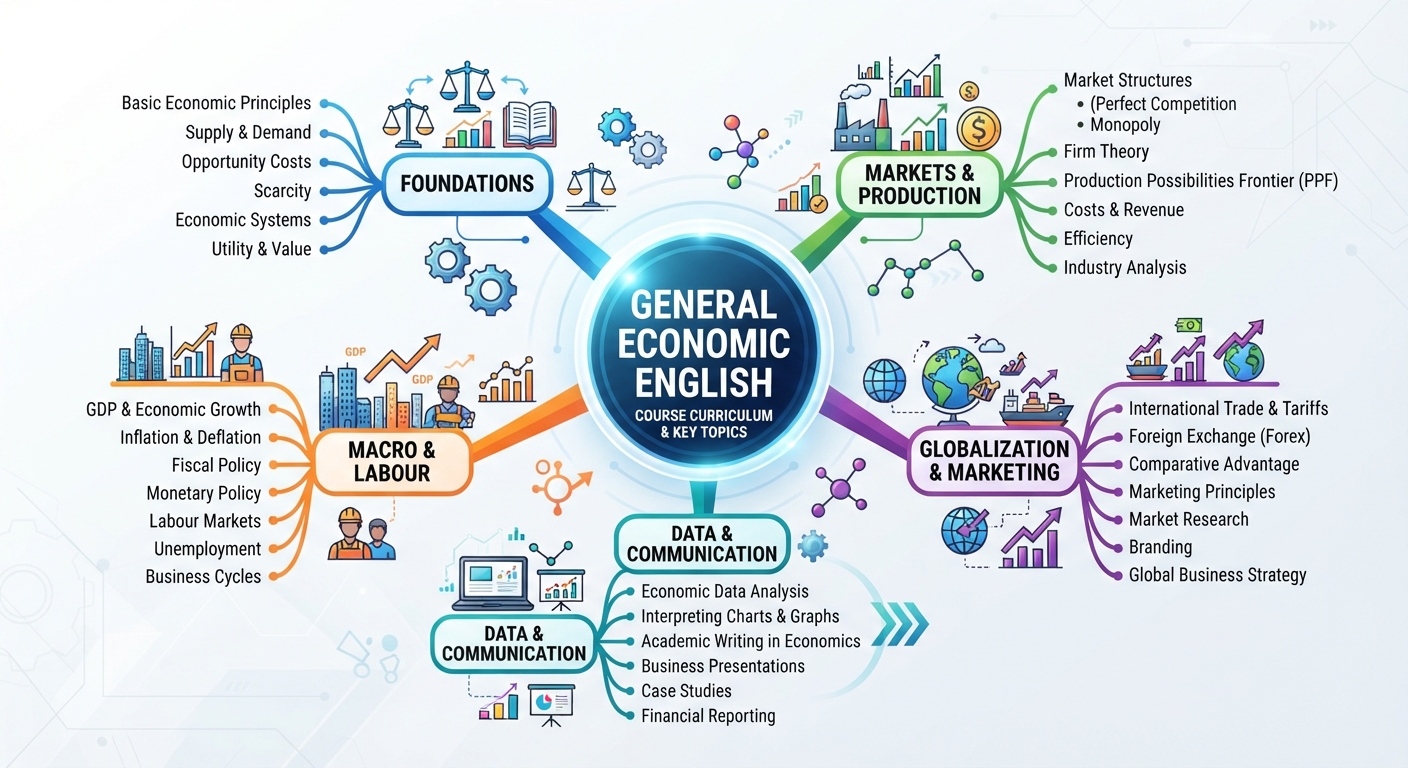
The general objective of General Economic English is to enable students to acquire the linguistic, communicative and introductory economic vocabulary necessary to understand, discuss and describe basic economic, commercial and managerial issues in English. By the end of the course, students should be able to communicate more confidently in academic and professional situations related to Economics, Business and Management.
-
-
-
To study this course successfully, students are expected to have prior knowledge of:
· Basic knowledge of General English.
· An approximate A2 CEFR level.
· Elementary knowledge of economics or business.
· The ability to understand short English texts.
· Basic knowledge of English grammar.
· The ability to write simple sentences and paragraphs.
-
-
-
Week 1: Introduction to Economics and Economic English
Week 2: Economic Agents and Economic Activities
Week 3: Scarcity, Choice and Opportunity Cost
Week 4: Supply, Demand and Markets
Week 5: Production, Costs and Productivity
Week 6: Firms, Entrepreneurship and Business Organizations
Week 7: Money, Banking and Financial Institutions
Week 8: Inflation, Unemployment and the Labour Market
Week 9: Economic Growth and Development
Week 10: International Trade and Globalization
Week 11: International Business and Multinational Companies
Week 12: Marketing, Consumers and Business Communication
Week 13: Economic Data, Tables, Charts and Graphs
Week 14: Economic Communication and Presentation Skills
Week 15: Comprehensive Revision and Integrated Economic English
-
-
-
-
Learning Outcomes & Objectives
By the end of this module, students will be able to:
• Define economics, scarcity, and resource allocation in English.
• Distinguish between 'economy', 'economics', and 'economic'.
• Explain the difference between microeconomics and macroeconomics.
-
-
-
Learning Outcomes & Objectives
By the end of this module, students will be able to:
• Identify the primary economic agents: Households, Firms, Government, and Financial Institutions.
• Describe core economic activities: Production, Consumption, and Investment.
• Explain the Circular Flow of Income model in English.
-
-
-
Learning Outcomes & Objectives
By the end of this module, students will be able to:
• Explain the fundamental economic problem of scarcity.
• Differentiate between basic human Needs and secondary Wants.
• Analyze economic decisions using the concept of Opportunity Cost.
-
-
-
Learning Outcomes & Objectives
By the end of this module, students will be able to:
• Explain the Law of Demand and the Law of Supply.
• Describe how price and quantity reach Market Equilibrium.
• Analyze market imbalances: Shortages and Surpluses.
-
-
-
Learning Outcomes & Objectives
By the end of this module, students will be able to:
• Identify the primary Factors of Production: Land, Labour, Capital, and Enterprise.
• Differentiate between Fixed Costs and Variable Costs.
• Calculate Total Cost, Total Revenue, Profit, and Productivity measures.
-
-
-
Learning Outcomes & Objectives
By the end of this module, students will be able to:
• Describe key business ownership structures (Sole Trader, Partnership, Corporation).
• Analyze the role of Entrepreneurship and Innovation in economic growth.
• Understand business plans, start-ups, and Small and Medium-sized Enterprises (SMEs).
-
-
-
Learning Outcomes & Objectives
By the end of this module, students will be able to:
• Explain the three core functions of Money.
• Distinguish between Central Banks and Commercial Banks.
• Understand interest rates, loans, deposits, and credit mechanisms.
-
-
-
Learning Outcomes & Objectives
By the end of this module, students will be able to:
• Explain Inflation and its impact on Purchasing Power.
• Identify types and macroeconomic causes of Unemployment.
• Analyze the Labour Market using wage and workforce indicators.
-
-
-
Learning Outcomes & Objectives
By the end of this module, students will be able to:
• Differentiate between Economic Growth and Economic Development.
• Interpret Gross Domestic Product (GDP) metrics in English.
• Analyze factors influencing Human Development, Inequality, and Poverty.
-
-
-
Learning Outcomes & Objectives
By the end of this module, students will be able to:
• Explain the mechanics of Imports, Exports, and the Trade Balance.
• Understand the theory of Comparative Advantage.
• Analyze Trade Barriers (Tariffs, Quotas) and Globalization impacts.
-
-
-
Learning Outcomes & Objectives
By the end of this module, students will be able to:
• Define Multinational Companies (MNCs) and corporate strategies.
• Understand Foreign Direct Investment (FDI) and market entry modes.
• Apply formal communication strategies in cross-cultural business environments.
-
-
-
Learning Outcomes & Objectives
By the end of this module, students will be able to:
• Explain the fundamental Marketing Mix (The 4 Ps: Product, Price, Place, Promotion).
• Analyze Consumer Behaviour and Target Market segmentation.
• Utilize descriptive and persuasive language in business marketing.
-
-
-
Learning Outcomes & Objectives
By the end of this module, students will be able to:
• Identify key visual data tools: Line graphs, Bar charts, Pie charts, and Data tables.
• Use accurate trend vocabulary (verbs, adverbs, nouns) to describe fluctuations.
• Summarize visual economic datasets into structured academic paragraphs.
-
-
-
Learning Outcomes & Objectives
By the end of this module, students will be able to:
• Structure an academic or business presentation on economic topics effectively.
• Master Signposting language for smooth oral transitions.
• Apply formal strategies for taking positions, agreeing/disagreeing, and answering Q&A.
-
-
-
Learning Outcomes & Objectives
By the end of this module, students will be able to:
• Synthesize core economic terminology across micro, macro, and international topics.
• Consolidate grammar frameworks: Tenses, Passive Voice, Conditionals, and Trend language.
• Apply integrated reading, writing, and analytical skills to real-world economic scenarios.
-
-
-
· CORE Econ Team. (2023). The Economy 2.0: Microeconomics. CORE Econ. https://www.core-econ.org
· CORE Econ Team. (2023). The Economy 2.0: Macroeconomics. CORE Econ. https://www.core-econ.org
· CORE Econ Team. (2023). Doing Economics: A practical introduction to economics. CORE Econ. https://www.core-econ.org
· McKenzie, I. (2023). English for Business Studies resources. Cambridge University Press.
· Mascull, B. (2023). Business Vocabulary in Use: Intermediate (4th ed.). Cambridge University Press.
· Parkinson, D. (2020). Oxford Business English Dictionary for Learners of English (2nd ed.). Oxford University Press.
· Jones, L. (2022). New International Business English: Communication skills in English for business purposes. Cambridge University Press.
· Cambridge University Press. (2024). Cambridge English for business and economics: Digital learning resources. Cambridge University Press.
· International Monetary Fund. (2024). World Economic Outlook. IMF. https://www.imf.org/en/Publications/WEO
· World Bank. (2024). World Development Report. World Bank. https://www.worldbank.org
· Organisation for Economic Co-operation and Development. (2024). OECD Economic Outlook. OECD Publishing. https://www.oecd.org/economic-outlook/
· United Nations Conference on Trade and Development. (2024). Trade and Development Report. United Nations. https://unctad.org
· MacKenzie, I. (2010). English for Business Studies (3rd ed.). Cambridge University Press.
· Cotton, D., Falvey, D., & Kent, S. Market Leader. Pearson Education.
· Emmerson, P. (2009). Business Vocabulary Builder. Macmillan Education.
· Murphy, R. (2019). English Grammar in Use (5th ed.). Cambridge University Press.
· Dudley-Evans, T., & St John, M. J. (1998). Developments in English for Specific Purposes: A Multi-Disciplinary Approach. Cambridge University Press.
-