-
Opened: Sunday, 2 November 2025, 12:00 AMDue: Sunday, 9 November 2025, 12:00 AM
-
-
-
Instructions:
Choose the correct answer (A, B, C, or D). Circle or tick the correct option.
-
References
American Speech-Language-Hearing Association. (1993). Definitions of communication disorders and variations. ASHA.
American Speech-Language-Hearing Association. (n.d.). Communication disorders. ASHA.
American Speech-Language-Hearing Association. (n.d.). Spoken language disorders. ASHA Practice Portal.
Individuals with Disabilities Education Act, 20 U.S.C. § 1400 et seq. (2004).
Owens, R. E., Jr. (2016). Language development: An introduction (9th ed.). Pearson.
Paul, R., Norbury, C. F., & Gosse, C. (2018). Language disorders from infancy through adolescence: Listening, speaking, reading, writing, and communicating (5th ed.). Elsevier.
Shipley, K. G., & McAfee, J. G. (2021). Assessment in speech-language pathology: A resource manual (6th ed.). Plural Publishing.
Yule, G. (2022). The study of language (8th ed.). Cambridge University Press.
-
-
SEQUENCE 1: SPEECH LANGUAGE PATHOLOGY
Section outline
-
Learning Outcomes
By the end of this lesson, students will be able to:
-
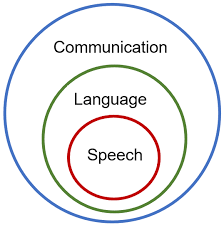
Define key concepts including communication, speech, language, and the main linguistic components (phonology, morphology, syntax, semantics, pragmatics).
-
Differentiate between speech and language and among related clinical terms such as articulation vs. articulation disorder, speech sound vs. speech sound disorder, and phoneme vs. phonological disorder.
-
Explain the scope and historical development of speech-language pathology (SLP) and describe the roles and responsibilities of speech-language pathologists.
-
Identify common speech, language, and communication disorders, including their causes, associated medical and developmental conditions, and impacts on communication and swallowing.
-
Apply basic diagnostic reasoning to simple case studies and recognize the importance of interdisciplinary collaboration in SLP practice.
-
Evaluate ethical and evidence-based approaches to assessment and intervention, demonstrating professional awareness and empathy toward individuals with communication difficulties.
-
Identify and locate major brain structures (frontal, temporal, parietal, occipital lobes, and cerebellum) and describe their basic functions related to speech and language processing.
-
Explain the localization of brain functions (motor, sensory, visual, auditory, and language areas), the role of the endocrine and autonomic nervous systems, and key studies such as Penfield’s interpretive cortex research.
-
Integrate knowledge from across the course to demonstrate a deeper understanding of the neurological and physiological bases of communication and speech.
-