
Table of Contents
Résumé de section
-
L
Quantum chemistry is a branch of theoretical chemistry that applies the principles of quantum mechanics to molecular systems in order to study chemical processes and properties.
The electronic and nuclear behavior of molecules, being responsible for chemical properties, can only be adequately described by the quantum equation of motion (Schrödinger equation) and the other fundamental postulates of quantum mechanics. This need has motivated the development of concepts (notably the molecular orbital) and numerical calculation methods that have enabled modern chemistry to make considerable progress, both in understanding phenomena and in their applications.
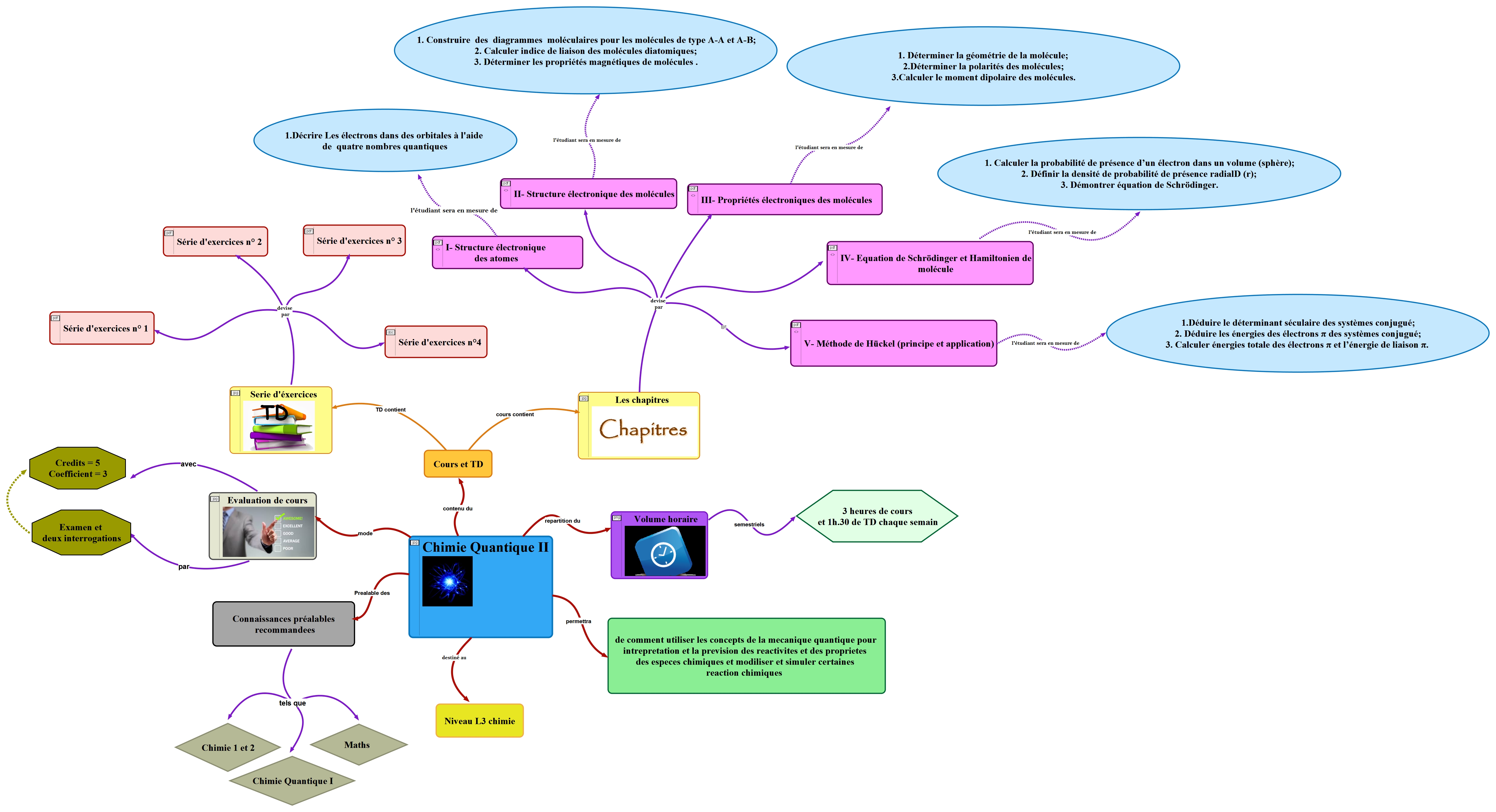
This course contains 5 chapters:
-
Chapter I: Electronic structure of atoms
-
Chapter II: Electronic structure of molecules
-
Chapter III: Electronic properties of molecules
-
Chapter IV: Schrödinger equation and molecular Hamiltonian
-
Chapter V: Hückel method (principle and application)
These chapters are presented progressively so that students can adapt to this new learning method. The theoretical course is reinforced by in-class assessment exercises and exercise sets solved during tutorial sessions. Students are also directed to online learning resources, such as online courses or more detailed explanatory videos.
-